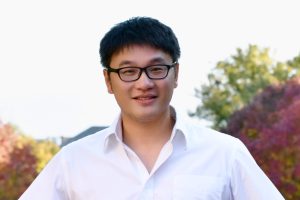
Zongwei Zhou—an assistant research professor of computer science and oncology at Johns Hopkins—and his co-authors have received the 2025 Best Paper Award from IEEE Transactions on Medical Imaging (IEEE T-MI) for their paper “UNet++: Redesigning Skip Connections to Exploit Multiscale Features in Image Segmentation,” which was published in the 39th volume of the journal in 2019.
IEEE T-MI focuses on unifying the sciences of medicine, biology, and imaging, emphasizing common ground where instrumentation, hardware, software, mathematics, physics, biology, and medicine interact through new analysis methods. Its prestigious Best Paper Award honors one paper each year that demonstrates exceptional innovation, quality, and impact in the field of medical imaging.
Work conducted while Zhou was completing his PhD at Arizona State University, UNet++ was recognized by IEEE T-MI for its significant and lasting contribution to medical image segmentation and its broad impact across the medical imaging community. Zhou shares the 2025 Best Paper Award with ASU colleagues Md Mahfuzur Rahman Siddiquee, Nima Tajbakhsh, and Jianming Liang.
UNet++ is a neural network that helps a computer trace the exact shape of what it sees in a scan, marking where an organ or tumor begins and ends. The network’s real strength lies in catching small objects—a great advantage in medicine, since an early-stage tumor can be only a few pixels wide and thus easy for human radiologists to miss. According to its creators, UNet++ finds these fine details more reliably than earlier neural networks, while running fast and light enough to fit in a mobile application.
According to Google Scholar metrics, UNet++ is the most cited paper in IEEE T-MI. Across its journal and conference versions, the paper has been cited over 20,000 times, and remains one of the most widely used segmentation architectures in medical imaging.
“Segmentation is where this line of work began, and it is still where many of the hard problems in this field live,” says Zhou. “But what drives my work at Johns Hopkins now is building systems that don’t just outline what a radiologist already sees—we want to create AI that helps catch cancer earlier than we can today. UNet++ was an important first step toward this future.”
At Hopkins, Zhou’s research focuses on medical computer vision, language, and graphics for early cancer detection and diagnosis. To this end, his medical AI lab builds foundation models for computed tomography and develops computer vision methods that can read multiple organs and cancers from a single scan and track disease progression over time.