
Three undergraduate students studying computer science were selected to participate in the 2026 Bloomberg Distinguished Professorships Summer Program, during which they worked with a Bloomberg Distinguished Professor (BDP) full-time for 10 weeks over the summer.
The BDP Summer Program was established in 2018 under the guidance of Vice Provost for Research Denis Wirtz. Summer research fellows are awarded a $6,000 stipend to cover summer living costs so they can fully devote themselves to their research projects.
This summer’s recipients from CS include:
 Malcolm Krolick, ’28
BDP Mentor: Steven Salzberg
Research Interests: Gene editing, mechanistic interpretability, sequence classification, longevity-adjacent research
Summer Research Project: Krolick designed tools for improving human gene translation initiation site annotation in the Salzberg Lab, working under Aleksey Zimin, a research scientist in the Department of Biomedical Engineering and a member of the Center for Computational Biology.
Why He Applied: During his internship at Basecamp Research, Krolick experienced firsthand the fluency with which people can tackle problems in their respective domains when they possess deep research experience. This inspired him to improve his domain knowledge in computational biology as fast as he could—while also working to become more research literate. Krolick says he doesn’t think there is any better way to achieve that goal than by distilling knowledge from the researchers here at Hopkins.
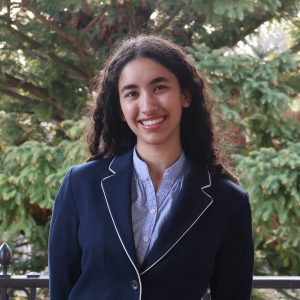 Navya Mehrotra, ’28
BDP Mentor: Gillian Hadfield
Research Interests: Computational social science and AI alignment—specifically, how social norms form, spread, and are enforced, and how to build AI systems that genuinely understand and participate in those processes rather than just approximate them
Summer Research Project: This summer, Mehrotra built computational frameworks to study one of the hardest open problems in AI: How do shared behavioral standards actually emerge and hold? Working in Professor Hadfield’s Normativity Lab, she developed cognitively grounded agents—including reinforcement learning systems—and ran simulations to study how populations coordinate, comply with, and enforce norms. The goal of this research was to move AI alignment from a theoretical aspiration toward something formally tractable.
Why She Applied: Mehrotra’s previous research experiences showed her how computational methods can be used to better understand large-scale human behavior and decision-making: In the Computational Social Science Lab with Kristina Gligorić, she worked on subjective reasoning and human perspectives in AI systems as first author of the paper “Multi-Perspective LLM Annotations for Valid Analyses in Subjective Tasks,” and through her work on the Delineo Disease Modeling Project and her BDP Summer Research Fellowship last year with Paul J. Ferraro, she became increasingly interested in how institutions, incentives, and social norms shape collective outcomes. The research Mehrotra pursued this summer brought together many of the questions she cares about most: how humans coordinate, how AI systems can better understand social behavior, and how computational models can help design more aligned and trustworthy systems.
 Kaan Eroltu, ’28
BDP Mentor: Paul J. Ferraro
Research Interests: Machine learning applied to medical imaging and high-dimensional biological data; convolutional networks for disease classification and evolutionary feature selection in oncology datasets; causal inference in observational health and environmental research; the intersection of hardware and software
Summer Research Project: Eroltu worked with Professor Ferraro on a quantitative bias analysis of the evidence linking prenatal acetaminophen exposure to autism, a question that has drawn considerable public attention. To this end, he assembled and screened primary studies, meta-analyses, and reviews; extracted effect estimates, exposure measures, and confounding-adjustment strategies from each; and conducted a random-effects meta-analysis of the sibling-comparison studies published to date, spanning cohorts in Sweden, Japan, Taiwan, Hong Kong, and Denmark.
Why He Applied: Eroltu’s earlier research in machine learning was less about building models than stress-testing them. For a tomato leaf disease classifier intended for farmers, he audited the entire EfficientNet family to see how architectural choices affected performance, and he later designed a genetic algorithm framework to optimize feature selection for breast cancer diagnosis. What carried over was the habit rather than the tools: questioning assumptions, probing methods, and asking how much a result depends on the decisions that produced it. Eroltu wanted to bring that scrutiny to causal claims in health and environmental policy, where experiments are often infeasible and where the credibility of a finding rests on design choices and identifying assumptions rather than on the estimate itself.