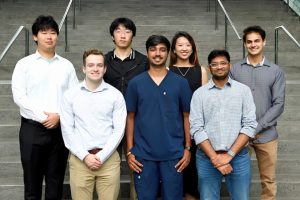
Seven students in the inaugural Johns Hopkins Data Science and AI Institute Internship Program presented the impactful research they completed this summer to address a wide range of real-world challenges, from accelerating materials discovery and improving clinical documentation to analyzing education policy and evaluating health outcomes.
During a final presentation showcase on Thursday, August 6 at the Mt. Washington campus, the interns highlighted their contributions, reflected on lessons learned, and demonstrated technical skills of how data science and AI can be applied. Faculty mentors invited five interns to continue their research beyond the summer program.
During the 10-week program, interns worked alongside faculty members from across the university and DSAI research software engineers to apply their technical skills to real-world research challenges while receiving mentorship and professional development.
“Internship programs like this create a valuable pipeline for the next generation of data science and AI talent. By working alongside faculty and research software engineers, students gain hands-on experience and mentorship, while our research teams benefit from new perspectives and innovative thinking. We are proud of what this year’s interns accomplished and look forward to building on this success in the years to come,” says Elizabeth Smyth, the executive director of the DSAI.
Research on educational reform
Jin Zhou, a graduate student of computer science at Johns Hopkins, worked alongside Jennifer Adams, an associate professor in the School of Education, to study how Chinese educational reform models over the past four decades may have influenced educational policies in Vietnam. Zhou used comparative policy analysis and large language model-assisted coding to analyze policy documents from China, Vietnam, and international organizations. He will continue this research during the fall semester.
Zhou learned key concepts in education research and the broader context of the project. “[Professor Adams] could have handed me a technical task and kept the theory on her side of the table,” he says. “Instead, she spent the summer making sure I understood why the distinctions we were coding mattered, the concept of ‘policy borrowing’ a plan or model that originated in a different country, what counts as evidence in comparative education, and where the real arguments in the field are.”
Materials discovery
Like Zhou, Yufei “Fay” Long, also a CS graduate student at Hopkins, spent the summer internship learning about a field outside her major. She worked alongside Jaafar El-Awady, a professor of mechanical engineering in the Whiting School of Engineering, to develop an active learning AI system that uses datasets and programs to identify materials—such as for alloy property prediction—faster and helps the system choose the parameters for subsequent experiments. The research will speed the development of new materials by helping scientists conduct experiments far more rapidly than individual, manual research and data analysis.
Long designed the system architecture that converts a manual materials-discovery workflow into an active learning-enabled multi-agent AI system for the autonomous lab, implemented the system backend, and tested and launched the web application. She said the internship’s interdisciplinary setting is what drew her to apply, and that the most rewarding part of the project was translating an abstract materials science machine learning workflow into a concrete AI system architecture.
She and fellow intern Evan Sponseller, an undergraduate studying computer science at Florida State University who also worked on the project, will both continue their research during the fall semester.
Pregnancy and antidepressants
A pair of interns were mentored by Casey Overby Taylor, an associate professor in the Whiting School of Engineering and the School of Medicine. Kiran Shay and Chenjia Zhang, both undergraduate students studying computer science at Johns Hopkins, explored the use of electronic health record data to identify and evaluate antidepressant side effects in pregnant people, with the goal of understanding the risks of neurodevelopmental problems in children exposed to the drugs.
Shay, who is also studying neuroscience, acknowledges that the research process could be complex. “A big part of my work involved digging into data quality issues that could bias the results, like inconsistencies in how often pregnant patients see doctors compared with non-pregnant patients,” he says.
Zhang shares that Taylor provided valuable guidance and mentorship during the internship program: “We worked with messy data and solved unexpected technical challenges, so it [was] helpful to have regular opportunities to meet with our mentor to discuss potential solutions,” he says.
AI-assisted scoring tools
Sathvik Manikantan Napa Ugandhar, a graduate student of computer science at Johns Hopkins, will also continue research alongside Carl Latkin, a professor in the Bloomberg School of Public Health and the School of Medicine, to develop an AI tool to better understand scoring tools for mental health screening, substance use, climate change, and social support. He explains that using AI adds nuance to the topics and can help clinicians use their time more efficiently when collecting information.
In addition to Latkin, Ugandhar received mentorship from Demitri Maestas, a DSAI research software engineer. “My mentors helped me understand how to move research from experimentation to implementation and provided valuable guidance throughout the project,” Ugandhar says.
For many participants, the program offered more than technical experience—it provided an opportunity to work closely with faculty mentors, contribute to active research projects, and build skills that will support their future academic and professional careers.
Applications for the next DSAI internship cohort will open in early 2027. Additional information will be available on the DSAI website.