
John C. Malone Professor of Computer Science Russell Taylor has been selected to receive the 2027 Institute of Electrical and Electronics Engineers (IEEE) Robotics and Automation Award for his contributions to, leadership in, and translation of surgical and medical robotics. One of the IEEE’s most prestigious honors, this award recognizes a select few extraordinary individuals’ contributions to and significant advancements in the field of robotics and automation.
Taylor was nominated for the award by Allison Okamura, currently the Richard Weiland Professor of Engineering in the Stanford University Department of Mechanical Engineering and formerly a professor in the Johns Hopkins Department of Mechanical Engineering.
“Russ Taylor is the father of surgical robotics,” says Okamura, whose position at Hopkins was part of the NSF-funded Computer-Integrated Surgical Systems and Technology Engineering Research Center led by Taylor. “Four decades ago, he saw that computers could make surgery safer and more precise, and so he built the field—from the ROBODOC system for hip surgery to the remote-center-of-motion mechanism that underlies the da Vinci surgical system now used in operating rooms worldwide.
“This award recognizes not just his inventions, but also his role as a leader and educator: He led the development of an entire discipline at the intersection of engineering and medicine.”
“Since meeting Russ as a graduate student over 40 years ago, I have witnessed his incredible drive for innovation, his formative role and decades of leadership in computer-integrated medicine, and his passion for making the world a better place by translating technology into real-world impact,” adds Gregory D. Hager, the Mandell Bellmore Professor of Computer Science at Johns Hopkins and Taylor’s longtime colleague. “I have long said that if there is a box, Russ is the person who could be guaranteed to think outside of it.”
Taylor’s research interests include artificial intelligence, robotics, human-machine cooperative systems, medical imaging and modeling, and computer-integrated interventional systems. His 50+ years of professional experience in the fields of computer science, robotics, and computer-integrated interventional medicine have led to over 650 peer-reviewed journal and conference publications and over 100 patents.
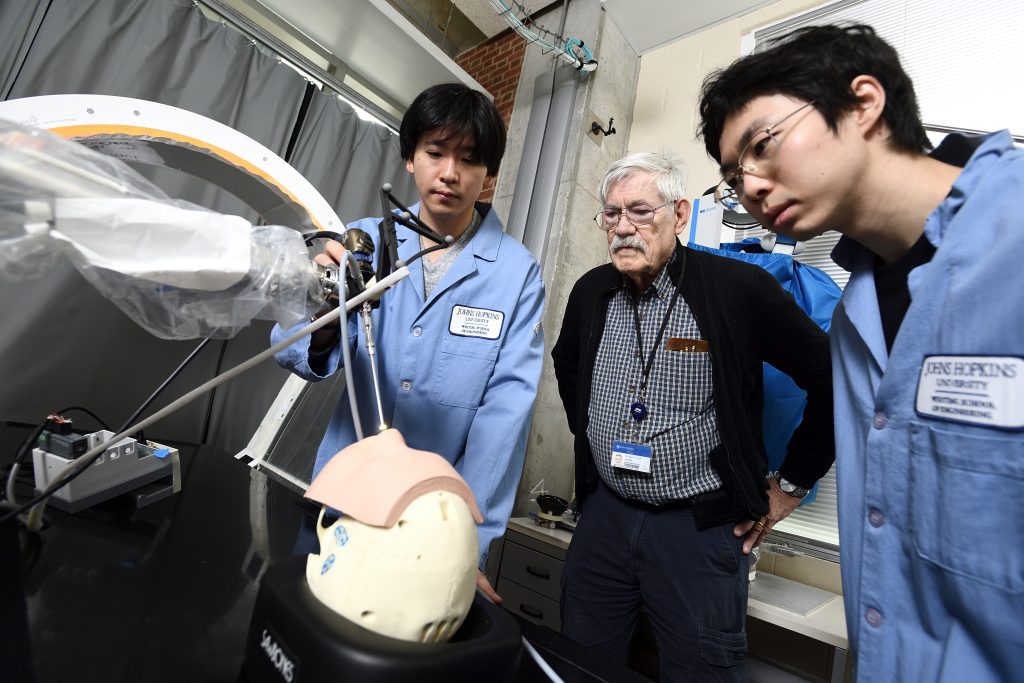
Image Credit: Will Kirk / Johns Hopkins University
A Fellow of the IEEE, the National Academy of Inventors, the American Institute for Medical and Biological Engineering, the Medical Image Computing and Computer Assisted Intervention (MICCAI) Society, and the Engineering School at the University of Tokyo and a Member of the National Academy of Engineering, he is also the recipient of numerous additional awards, including the Maurice Müller Award for Excellence in Computer-Assisted Orthopaedic Surgery, the IEEE Pioneer in Robotics and Automation Award, the MICCAI Society Enduring Impact Award, the Engineering in Medicine and Biology Society’s Technical Field Award, and the Honda Prize.
Taylor holds secondary appointments in Mechanical Engineering, Radiology, Surgery, Nursing, and Otolaryngology—Head and Neck Surgery at Johns Hopkins, where he is continuing to make substantial contributions in all aspects of medical robotics, including mechanism development, robot systems and control, image analysis and image guidance, human-machine interfaces, and a wide range of application areas, including orthopedics, minimally-invasive endoscopic surgery, image-guided needle placement, ophthalmology, otology, laryngology, sinus surgery, and radiation oncology.
As for the future of the field, Taylor points to the extraordinary advances in computational capabilities and technology in recent years that are beginning to enable the us to develop systems with increasing “embodied intelligence.”
“I am most excited by the prospect of developing more and more capable human-machine partnerships in healthcare,” he says. “In addition to surgery, I think that there are enormous needs—and opportunities—in nursing and clinical care. Beyond this, I expect to see similar partnerships evolving in many other fields, presenting both great challenges and great opportunities for our society.
“In terms of the impact of technological change, the promise and the peril are there for all of us.”