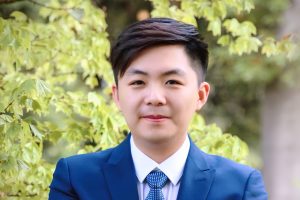
Haimin Hu joins the Johns Hopkins University as an assistant professor of computer science, a member of the Data Science and AI Institute (DSAI), the Laboratory for Computational Sensing and Robotics (LCSR), and the Institute for Assured Autonomy (IAA).
Hu received his PhD from Princeton University. Before joining Hopkins, he was a postdoctoral fellow at the Penn Research In Embedded Computing and Integrated Systems Engineering Center and the General Robotics, Automation, Sensing, and Perception Lab at the University of Pennsylvania. During his PhD, he also spent time working with industry partners such as the Toyota Research Institute and the Honda Research Institute.
Tell us a little bit about your research.
My group studies the algorithmic foundations of human-centered robotic systems, such as autonomous vehicles, home robots, and shared control systems. Our work integrates insights from dynamic game theory, machine learning, and safety-critical control to ensure robots are safe, performant, and verifiable when deployed in human-populated spaces. At the core of our work lies a fundamental question: How can robots and humans safely learn and grow together?
Currently, our key research thrusts include:
- Human-robot co-evolution: How can robots learn from and adapt to human teammates while helping them acquire and practice new skills in a safe, personalized manner?
- Reliable and competitive agility: How can agile robots plan safe and competitive motion by accounting for evolving interaction uncertainty and their ability to safely reduce it through future interaction, sensing, communication, and learning?
- Safe and human-compatible autonomy: How can robot teammates ensure prescribed safety while remaining aligned with human values and attuned to human cognitive limitations?
-

Examples of ongoing robotics projects in Hu’s Alliance Lab, located in Malone Hall G61.
Tell us about a project you are excited about.
As AI technology advances, it is no longer surprising to see superhuman robots. But what role should these robots play in our lives? Should they replace us, or can they also help us learn and grow? Recently, I’ve been excited about building personalized AI coaches that help people develop skills that they can use on their own. Think about learning to drive a race car with an AI copilot; it could improve every lap by correcting your steering and braking, yet leave you no better prepared to race another human once the assistance is gone. We therefore want to train the AI coach by rewarding it for the human’s independent competence after the coaching ends. The interesting part is that both the human and AI are changing: As someone learns, the AI has to revise its understanding of the human’s abilities and discover new ways to teach them. We’re using game theory to describe this closed-loop process and we’re leveraging foundation models to expand the strategy space on the fly and provide multimodal assistance, from shared control to verbal instructions to visual cues.
Our Learning to Coach work, in collaboration with researchers from the University of Pennsylvania, takes an initial step in this direction: In a drone-racing user study, participants who had never operated a high-speed drone before were able to reduce their unassisted lap times by 28% after about 40 minutes of training with our AI coach. Another challenge here is to keep this learning process physically safe without limiting the learner’s practice opportunities. Building on our human-centered safety filtering work, we’re exploring ways that the AI coach can anticipate human-induced hazards and offer timely guidance to nudge the human toward safer actions, before any physical intervention is needed.
Why this? What drives your passion for your chosen field of human-centered robotics and AI?
I’ve been fascinated by robotics and intelligent systems since childhood, when I’d spend entire days watching sci-fi anime like Mobile Suit Gundam, Neon Genesis Evangelion, and Future GPX Cyber Formula. What intrigued me back then wasn’t just the futuristic technology, but the vision of AI as a true partner that augments human abilities rather than replaces them. Cyber Formula in particular planted the idea of human-AI co-evolution in my mind: an AI co-pilot that not only helps a human driver navigate high-speed, high-stakes environments, but also adapts to the driver’s style over time, ultimately making the human a better racer and deepening mutual trust along the way.
The android Data in Star Trek showed me the other half of that relationship. Data is built to outperform his human crewmates in every measurable way, yet he spends the entire series learning from them: what a joke is, when to bend a rule, why a friend matters. The crew trusts him with their lives, and he becomes more capable, and more himself, through that trust.
During my earlier collaboration with the Toyota Research Institute, I worked on human-centered AI systems that collaborate with people in dynamic, safety-critical settings by rapidly aligning with human intent through multimodal inputs—from physical assistance to visual cues and language feedback—bringing to life the very ideas that once lived in my childhood imagination.
What classes are you teaching?
I teach a new course called Human-Centered Robotics: Models and Algorithms. It covers fundamental concepts in human-centered robotics, with an emphasis on mathematical models of human-robot interaction and decision-making algorithms for safely deploying robots in human-populated environments. We will start by introducing the main technical tools for robot planning and control in interactive, safety-critical settings through a game-theoretic lens. After that, we will turn our attention to human-centered robot learning and try to answer two tightly coupled questions: How can robots learn to safely work with humans? and How can they help humans learn? After this class, students will be familiar with the state of the art and open challenges in physical human-robot interaction, and understand the guarantees and tradeoffs offered by different algorithmic frameworks for human-centered robotics.
Why are you excited to be joining the Johns Hopkins Department of Computer Science?
I’m excited to join the Department of Computer Science because it uniquely brings together the diverse perspectives needed to build robots that learn and work alongside people. Our colleagues are studying how machines understand human intentions, interact with people, and extend human abilities. And although I’ve been here only about four months, I’m already starting new collaborations, and nearly every week brings a new conversation and exciting ideas. The department also plays a critical role in several university-wide research centers: The LCSR connects my ideas in human-centered robotics to high-stakes applications ranging from rehabilitation systems to surgical robotics, while the DSAI and IAA provide an intellectual home for studying fundamental questions in AI assurance and AI that supports human learning.
Besides your work, what are some of your other hobbies and passions?
I am passionate about skiing. I learned to ski primarily by vision-based imitation learning from a chairlift, though I’m definitely paying the price now for poor generalization! One day, I hope to build an exoskeleton that teaches me to ski better while keeping me safe on the double black diamonds.