
Six primary CS faculty members and their collaborative research teams have been chosen to receive 2026 Johns Hopkins Discovery Awards. Chosen from 324 proposals, Anjalie Field, Kristina Gligorić, Gillian Hadfield, Chien-Ming Huang, Tiziano Piccardi, and Tianmin Shu are among the 132 individuals on the 40 multidisciplinary endeavors that have been selected to receive support this year.
The Discovery Awards program was announced in early 2015, as was the Catalyst Awards program for early-career researchers. Together the two programs represent an $85 million university commitment by university leadership, along with the deans and directors of JHU’s divisions, to faculty-led research.
The Discovery Awards are intended to spark new interactions among investigators from across the university and harness their collective knowledge to advance discovery. Teams can apply for up to $150,000 to explore a new area of collaborative work with special emphasis on preparing for an externally funded large-scale grant or cooperative agreement.
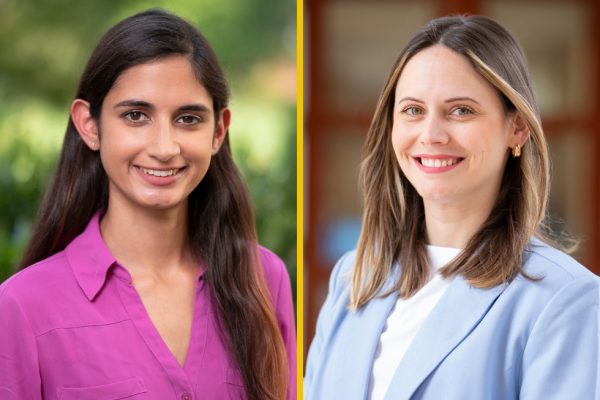
Anjalie Field and Kristina Gligorić
Field’s research focuses on the ethics and social science aspects of natural language processing, while Gligorić’s work focuses on developing and applying large language model methods to understand, simulate, and change human behavior, with an emphasis on diet and health. Joined by Roy Adams and Ananya Joshi, both assistant professors of psychiatry and behavioral sciences and computer science, they will explore “Tracing the Impact of AI Scribes on the Content of Mental Health-Related Clinical Notes.”
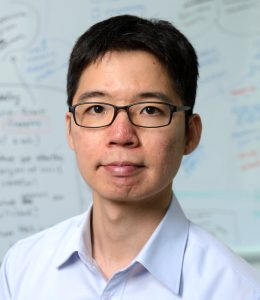
Chien-Ming Huang
Huang studies human-machine teaming and creates innovative, intuitive, personalized technologies to provide social, physical, and behavioral support to people with a variety of abilities and characteristics, including children with autism spectrum disorders. He will work with Hsin-Ya Tang, an associate professor in the School of Education, on “Social Robots for Enhancing Counselor Linguistic Responsiveness in Untranslatable Contexts.”
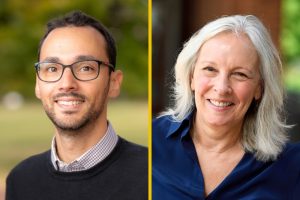
Tiziano Piccardi and Gillian Hadfield
Piccardi’s research focuses on social computing, artificial intelligence, and web research, with the goal of improving the design of online platforms, while Hadfield’s research is focused on innovative design for legal and regulatory systems for AI and other complex global technologies, computational models of human normative systems, and working with machine learning researchers to build systems that understand and respond to human values and norms. Together, along with Cameron Martel, an assistant professor at the Carey Business School, they will research “Engineering Public Reason: Measuring Normative Agreement Through Multi-Agent Deliberation.”
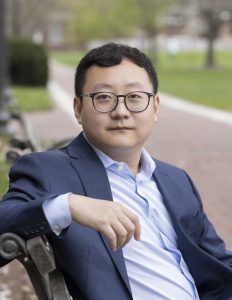
Tianmin Shu
Shu’s research goal is to advance human-centered artificial intelligence by engineering machine social intelligence to build systems that can understand, reason about, and interact with humans in real-world settings. He will work on “Open-World Human-Robot Collaborative Scouting” with Bloomberg Distinguished Professor of Computer Vision and Artificial Intelligence Rama Chellappa and Corban Rivera, a senior scientist at the Applied Physics Laboratory.