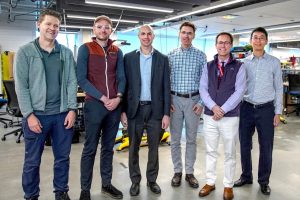
Three Johns Hopkins teams have won funding through the latest cycle of the SURPASS initiative, a joint effort between the Johns Hopkins Applied Physics Laboratory in Laurel, Maryland, and the Johns Hopkins University’s Whiting School of Engineering in Baltimore to tackle ambitious, high-impact challenges.
SURPASS provides up to $3.75 million to support cross-divisional teams pursuing innovative, multidisciplinary research. Each team is led by two principal investigators, one from APL and the other from WSE, and collaborates with researchers across the Johns Hopkins University ecosystem.
“SURPASS pushes the boundaries of research and innovation,” says WSE Dean Ed Schlesinger. “The ambitious scope of these projects reflects the power of bringing together APL’s mission-focused expertise and WSE’s diverse engineering capabilities. Together, they’re tackling challenges that have the potential to transform entire industries and improve lives around the world.”
The program’s latest cycle, its third, received 31 submissions, three of which were selected to receive funding and have 18 months to conduct their research.
“The complexity of the challenges the SURPASS teams are taking on really demonstrates their commitment to creating game-changing advances,” says APL Director Dave Van Wie. “These bold projects exemplify the kind of visionary, collaborative research that happens when APL and WSE are united.”
One of the research teams that received SURPASS funding this year is led by John C. Malone Associate Professor Mathias Unberath and Corban Rivera, a senior scientist at APL. Their team’s project, “Autonomous Robotic Surgery for Xenotransplantation at Scale,” will work to address the challenges associated with organ transplants.
Thousands of Americans die each year while waiting for an organ transplant. Even for patients who receive one, access to highly skilled surgeons remains a challenge, particularly in underserved areas.
To help address that problem, the team will work to develop an autonomous robot for procuring pig kidneys; the project builds on advances in xenotransplantation, an emerging field that explores the use of animal organs for human transplantation.
“Autonomous robotic surgery is on the critical path to help solve the organ shortage,” says Unberath. “This work builds the foundation for its broader adoption in and around the operating room.”
The team will draw on robotics and surgical expertise across APL, WSE, and the School of Medicine to advance automated surgical capabilities that could help improve access to and the quality of surgery, addressing a public health crisis and paving the way for the future of automated surgery.
Johns Hopkins Hospital is a world leader in xenotransplantation research and has 25 xenotransplantation surgeries planned this year, says the hospital’s surgeon-in-chief Andrew Cameron. To put that in perspective, only four living people in the U.S. have received a xenotransplantation as of early 2026. The team already has a venture-backed spin-out company that will help transition their research products to the market when ready.
“It’s far down the road, but this work is best done at a place like Johns Hopkins and APL, with incredible expertise in clinical medicine, surgery, engineering, and a commitment to seeing where AI can take us,” Cameron says.