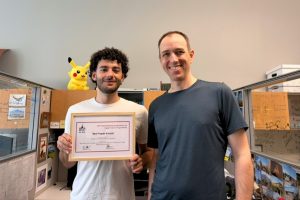
Professor Ben Langmead and Nathaniel K. Brown, a PhD student in the Langmead Lab, received a Best Paper Award for their work, “Bounding the Average Move Structure Query for Faster and Smaller RLBWT Permutations,” at the 24th Symposium on Experimental Algorithms (SEA), held June 22–24 in Copenhagen, Denmark.
SEA solicits research from computer science, operations research and mathematical programming, and other scientific communities to explore the role of experimentation and engineering techniques in the design and evaluation of algorithms and data structures.
Holding a joint appointment in the Department of Biostatistics at the Johns Hopkins Bloomberg School of Public Health, Langmead is recognized across the computational and life sciences fields for his innovative methods for analyzing high-throughput biological datasets, which are helping to transform how biomedical researchers and other life scientists access and use DNA sequencing data. For example, these data can be used to map a patient’s unique genetic code to guide custom disease prevention, diagnosis, and treatment.
But to make personalized medicine truly equitable, Langmead explains, researchers must compare patient DNA against massive global datasets rather than a single historical reference genome. However, storing and processing this sheer volume of data creates a major computational bottleneck. This challenge has jumpstarted the field of computational pangenomics, which focuses on cleverly compressing these massive datasets into smaller representations.
Advancing this effort, Brown and Langmead’s research introduces “length capping,” a novel data compression technique that allows the representation of massive genomic datasets in a highly compressed format by chopping up overly long blocks of data into manageable pieces, thus speeding up DNA searches while using significantly less computer memory.
This line of work bridges the gap between theory and practice, proving that theoretical computer science can deliver tangible, real-world results—namely in the form of Orbit, an open-source software library that packages the scientists’ research breakthroughs into a practical framework to support genomic search of massive collections and to accelerate the development of bioinformatics methods at scale.
“As genomic datasets grow, we need smarter ways to search through massive collections of repetitive DNA sequences,” says Brown, who is first author on the winning paper. “Our work shows that algorithmic advancements really do pay off in practice.”