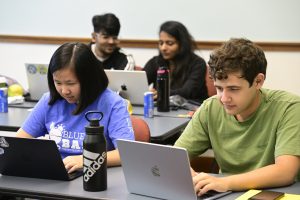
From friendships formed over an impromptu piano performance in the Glass Pavilion to the first-place general track prize winner missing her flight for the honor, the 20th instance of HopHacks did not disappoint.
Hosted by the Whiting School‘s Department of Computer Science, the student-run hackathon has taken place annually or biannually on the Homewood campus since 2012. Last semester’s 36-hour-long event, which took place from September 12–14, boasted nearly 300 participants from 57 different universities who submitted a record-breaking 102 projects.
Top submissions were awarded cash prizes based on their utility, polish, creativity, and technical difficulty as judged by 35 local tech professionals and Johns Hopkins faculty. Students could also submit their hacks to challenges sponsored by industry partners such as Commure, SpacetimeDB, and more.
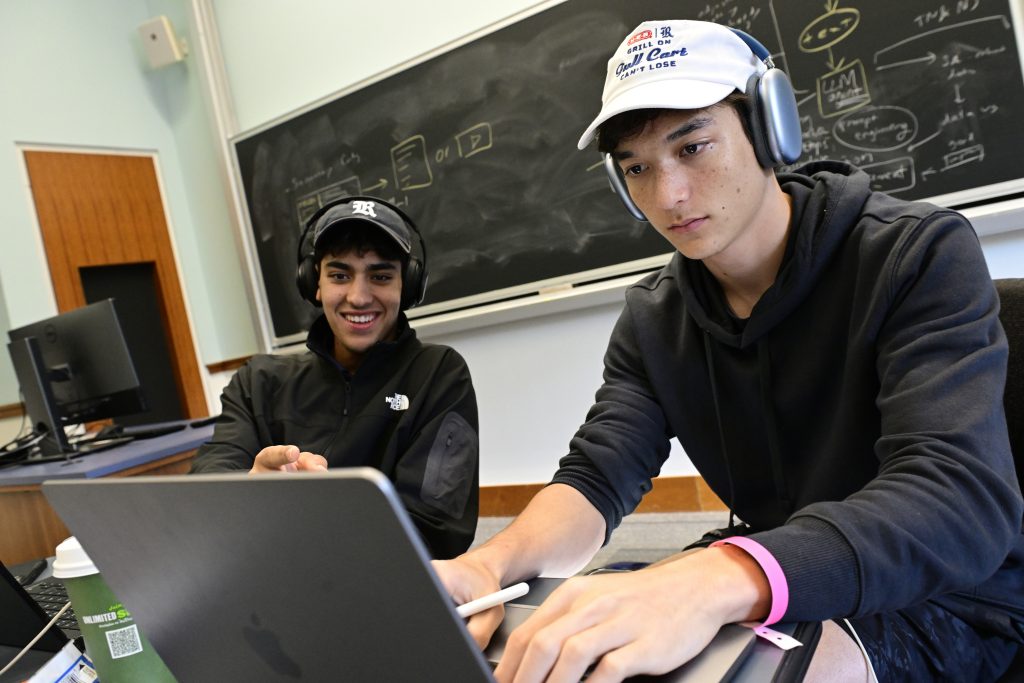
Image Credit: Will Kirk / Johns Hopkins University
“Even an original HopHacks organizer, Tyler Cloutier—who designed the original HopHacks logo—returned as a sponsor this year with his own venture-backed game studio, Clockwork Labs,” notes Joanne Selinski, the department’s director of undergraduate studies and HopHacks’ faculty advisor.
The student organizers began their preparations for the annual event in November 2024, working through the spring semester and summer to stay on track for the fall hackathon and to leave enough time to account for the unexpected—this year, the sheer volume of submissions thanks to the use of AI tools.
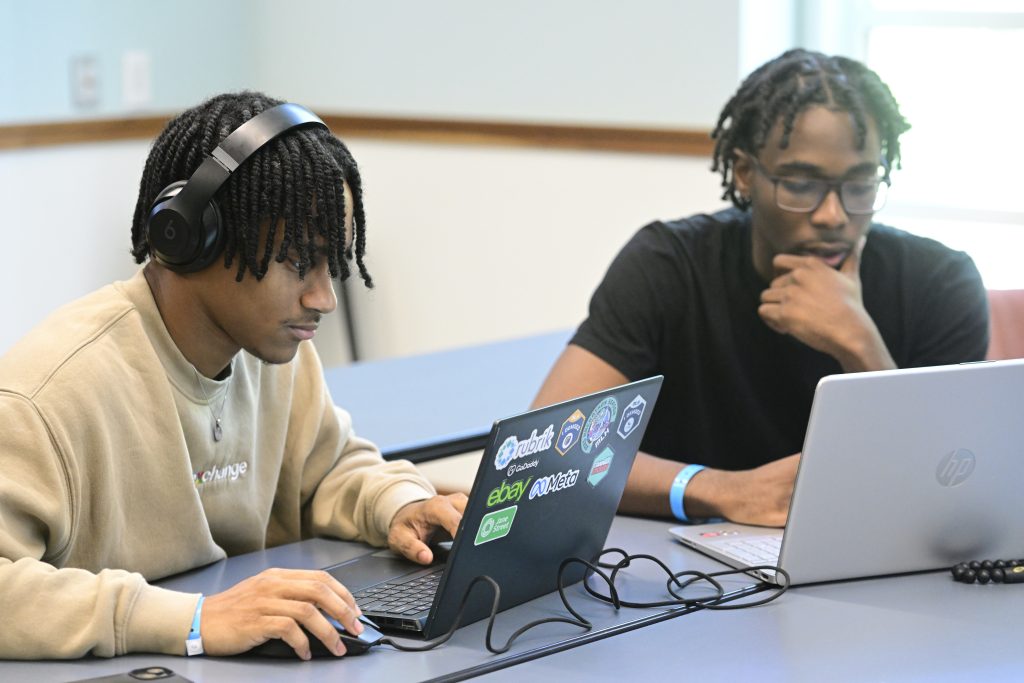
Image Credit: Will Kirk / Johns Hopkins University
“A lot more projects are incorporating AI. Even when the core idea isn’t strictly AI-focused, teams are often using machine learning models, APIs, or intelligent automation as a component, which shows how accessible and mainstream these tools have become for hackers,” remarks student organizer Ronit Sohal, a second-year computer science and applied mathematics and statistics double major.
“I’ll admit we were surprised by how many projects ended up being submitted—we even had to adjust our judging algorithm at the last minute,” says HopHacks director Lucy Wu, a fourth-year CS and AMS double major.
But despite the last-minute modifications, the final awards ceremony went off without a hitch. Learn more about some of the winning projects below.
A team of JHU first-year undergraduate students—Tanya Nair, Kinnera Tirumala, Ujjwal Kaur, and Naavya Jain—won first place in the Best Data Visualization challenge posed by Marshall Wace with their personal reflection engine, sine.
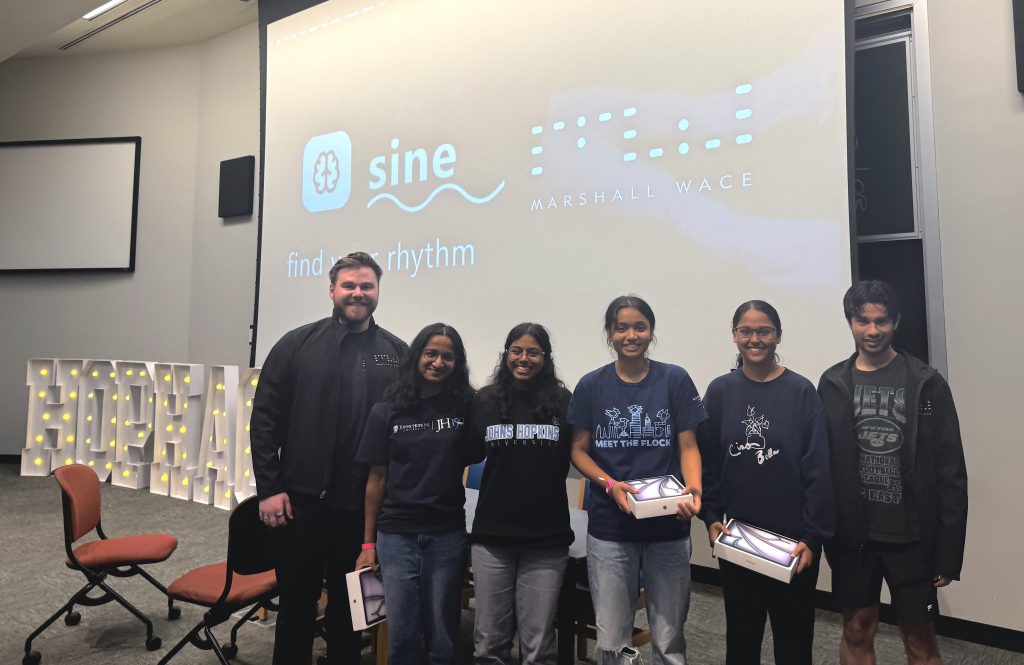
Image Credit: HopHacks
The electrical and computer engineering and CS majors wanted to help other new college students manage their mental health. Knowing from experience that many students don’t have the time to cultivate a regular journaling practice, the team coded an AI application so that a single check-in via text, voice, or video can be transformed into bite-sized summaries, actionable advice, and motivational prompts.
“I bonded deeply with my teammates; they’re now some of my closest friends at Hopkins because of all the hours we spent debugging our code, laughing over random jokes, and pushing through exhaustion to finalize our project,” says Nair. “Before participating, I worried that I wouldn’t feel a sense of belonging at Hopkins, but HopHacks became one of my favorite experiences because it showed me that I had found a place and a community here.”
Another Hopkins submission, the voice-based web agent Dom, was born of a different kind of personal experience: trying to type on a keyboard with cheese dust-covered fingers.
“This simple frustration sparked a bigger realization: If we were struggling with web navigation, what about people who face these challenges every day?” the team writes on its project webpage. “People with motor disabilities, visual impairments, or injuries who can’t easily use traditional interfaces deserve the same seamless web experience.”
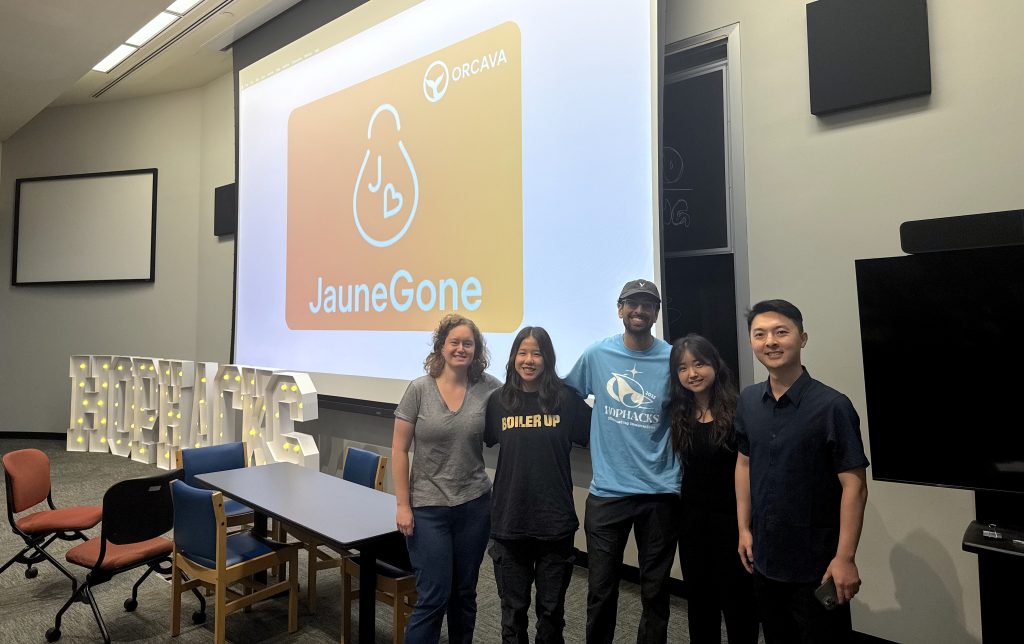
Image Credit: HopHacks
The four CS students—seniors Yoohyuk Chang, Jooyoung “Eric” Ryu, and Sanghyup Lee, plus junior Yongjae Lee—went on to build an AI agent that understands user intent from voice commands, making the web more navigable for everyone and earning them second place in Bloomberg’s Best Application to Support Philanthropic Goals challenge.
In a similar vein, graduate students Samantha Ehlers, Chia-Hua Lin, Saahil Sachdeva, and Minseo Song wanted to help parents diagnose jaundice in newborn babies from the comfort of their own home.
Combining their expertise in security informatics and biomedical engineering, the students developed a smartphone app that analyzes pictures of a newborn baby’s body, eyes, and feet to determine the likelihood that the infant is suffering from this widespread, and potentially deadly, condition. Their hack, JauneGone, won second place in Orcava’s AI + AR in Material Wellness track.
“This was our biggest year yet, with an unprecedented number of submissions, both new and returning sponsors, and, as always, tons of caffeine,” remarks Wu. “It’s always a pleasure to be able to host students from across the country at Hopkins for the weekend, and it’s worth all the late nights to see their ambition grow each year.”
See the full list of winners and submissions here.
Image Credit: HopHacks