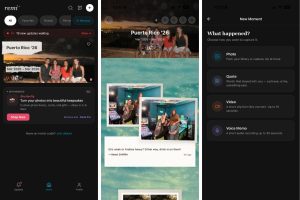
Taking gigabytes of photos during a trip or an event may help to preserve your memory of that experience at first, but over time those photos can lose context and meaning—leading you to eventually ask, “Why did I save that in my camera roll?”
Inspired by the struggle of documenting their own recent events and trips, recent computer science graduates Kurtis Yoon and Katie Cariaga, plus electrical and computer engineering graduate Gabrielle Chavez, set out to solve this problem—and created Remi, a collaborative platform that helps people turn meaningful experiences into shared stories by capturing different perspectives of the same moment in a simple, structured way.
Developed as part of the students’ CS Innovation & Entrepreneurship course, Remi helps both individual users and groups of friends automatically turn photos, audio recordings, videos, and notes into a cohesive virtual album. Users simply upload a “moment,” note its significance, and move on to the next memory, with the added ability to comment on friends’ moments and share additional context.
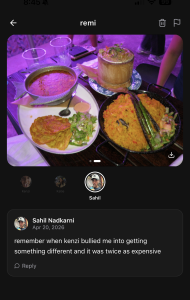
Comments on moments capture additional context that would otherwise be lost.
“Instead of sorting through hundreds of photos after the fact, the album builds itself as the experience unfolds, with each group member contributing their own perspective along the way,” explains Chavez, who experienced firsthand the burden of trying to sort through over 600 photos of a recent trip to California—and remembering all the quotes and inside jokes that accompanied those moments.
One friend no longer has to carry the overwhelming responsibility of organizing the memories of a group outing; Remi’s moments can live on indefinitely as a digital album or be easily exported into a high-quality physical photo book complete with pictures, quotes, and different perspectives all tied together, making it easy to share with friends and family.
“We wanted to create a memory-sharing experience that is genuinely different from traditional social media, not just another app for posting photos,” Chavez explains. “That meant rethinking the user interface from the ground up so that it encourages reflection, perspective, and collaboration—rather than passive scrolling.”
The idea was that Remi would inspire more genuine interaction without the pressure of posting for an audience of strangers. This hit home with their peers; when the team first demonstrated its project in class, other students immediately created a “Meme” album to share funny graphics and jokes.
“It was so much fun seeing people test our product and really push it to the limit,” Chavez recalls.
The team submitted Remi to Hopstart, an annual startup competition hosted by the Center for Leadership Education that challenges Hopkins students to develop a business plan and pitch it to industry leaders. This was the first time any members of the team participated in the event.
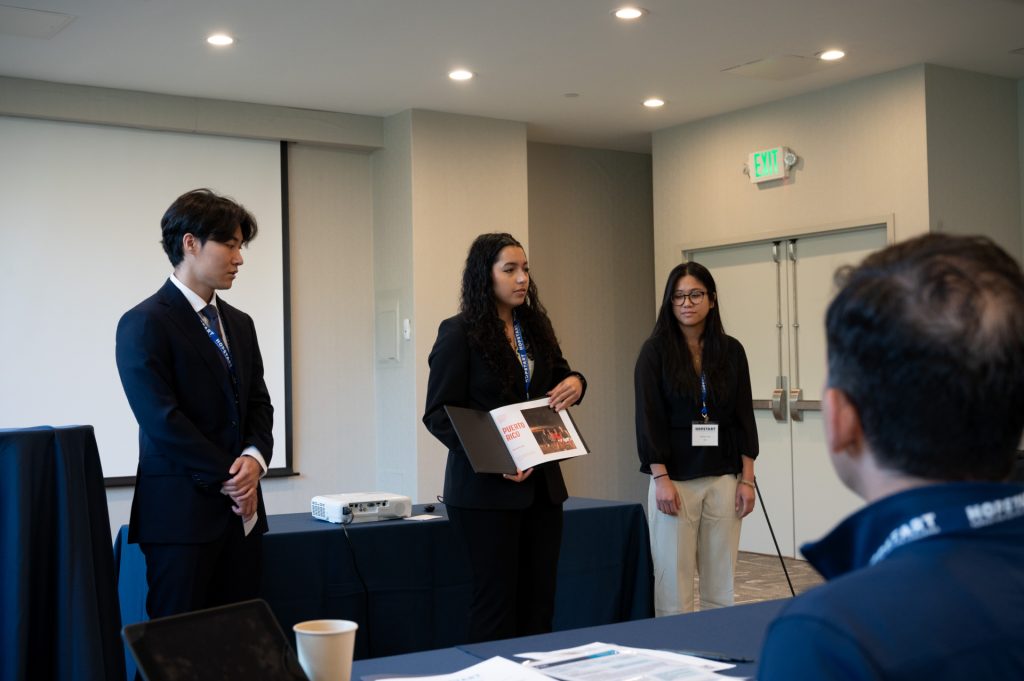
The Remi team presents at Hopstart.
“Hopstart was a great experience; it was thrilling to pitch our product and show off what Remi can do,” Chavez says. “Katie was even able to create a sample physical album to show the judges.”
Although the students won’t be continuing their work on Remi this summer after having graduated, they appreciate the experience they had developing the product together and learning about what other Hopkins students value when preserving important memories.
“We found that people care deeply about saving meaningful moments in their life—the problem is that when someone tries to preserve a shared experience, the process is fragmented, manual, and easy to abandon,” Chavez says. “Remi not only streamlines this process, but captures those moments in a way that goes beyond just photos and videos, preserving what people said, how they felt, and the stories behind those memories.”