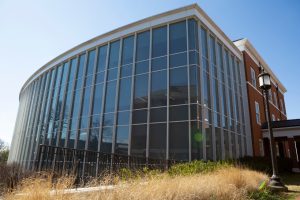
Four computer science majors are among the 33 undergraduate students who received a Provost’s Undergraduate Research Award (PURA) this year.
Provost Joseph Cooper (1991-1995) established the PURA program in 1993 with a generous endowment by the Hodson Trust to support and encourage Hopkins undergraduates to engage in independent research and scholarly and creative projects. Each awardee receives a $3,000 grant that will allow them to work on a project over the academic year with the assistance of a Hopkins mentor.
This year’s CS undergraduate recipients include:
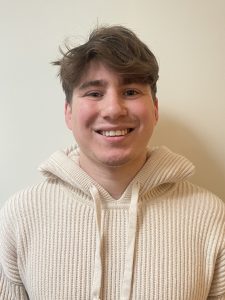 Jake Hoffman, ’26
Project: Theory for Increased Magnetic Memory Density Through Controlled Meron Motion
PURA Mentor: Oleg Tchernyshyov
CS Advisor: Enrique Mallada
Research Interests: Quantum information and algorithms, magnetism, exotic superconductivity
Project Description: Hoffman’s research develops a theoretical framework for controlling merons—localized defects that act as information bits—within domain walls of ferromagnetic thin films. By modeling the domain wall as a vibrating string and the meron as a charged bead that moves along it, he’s uncovering how external fields, currents, and spin waves can be used to guide its motion. He will be validating these predictions with GPU-accelerated micromagnetic simulations.
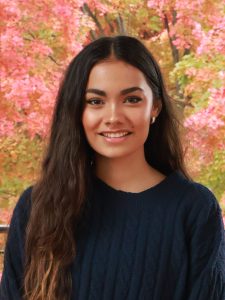 Anvii Mishra, ’26
Project: Keeping the Conversation Going: Personalization and Engagement in Repeated Human-Robot Sessions
PURA Mentors: Chien-Ming Huang, Kaitlynn T. Pineda
CS Advisor: Tianmin Shu
Research Interests: Human-computer interaction, human-robot interaction, human-AI interaction
Project Description: This project focuses on enabling long-term, personalized small talk in social robots by designing conversational behaviors that feel more natural and consistent, allowing relationships to be built over repeated interactions. To this end, Mishra is developing a system that models user preferences, conversational history, and contextual cues so a robot can engage in meaningful, evolving small talk rather than isolated exchanges, with the broader aim of deepening sustained human-robot rapport.
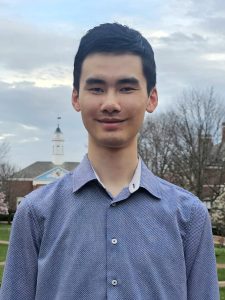 Edmund Sumpena, ’26
Project: Vascular Atlas based on Neural Template-Aligned Graph Encodings
PURA Mentors: Craig Jones, Amir Kashani
CS Advisor: Craig Jones
Research Interests: Deep learning and computer vision in medical imaging; developing computational models of neurons, brain circuitry, and ocular anatomy
Project Description: Just as geographic maps revolutionized navigation, anatomical atlases have transformed modern medicine—particularly neuroscience—by providing standardized boundaries of structures, enabling population-level comparisons and supporting disease detection and monitoring. Building on this paradigm, this project aims to develop the first deep learning-based pipeline for constructing a comprehensive atlas of the retinal vasculature, with the potential to enable new discoveries about regional vascular patterns and their relationship to disease progression.
Additionally, Chuntung Zhuang, ’27 will be pursuing the project “Rewinding Late-Stage CT Scans: A Generative AI Approach for Early Pancreatic Cancer Detection” under the guidance of his PURA mentors Zongwei Zhou and Alan Yuille.