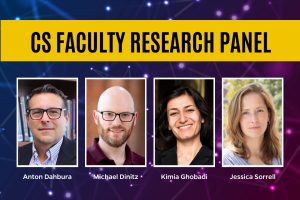
Faculty will present on their own research and areas of specialty and answer questions you might have on how to apply your degree to the broader world of computer science, at Hopkins and beyond.
Learn more about the faculty presenting:
 Anton Dahbura
Anton Dahbura is the executive director of the Johns Hopkins University Information Security Institute, co-director of the Institute of Assured Autonomy, and an associate research scientist in the Department of Computer Science. He is additionally affiliated with the Malone Center for Engineering in Healthcare, the Laboratory for Computational Sensing and Robotics, and the Data Science and AI Institute, and leads the university’s Sports Analytics Research Group. His research focuses on security, fault-tolerant computing, distributed systems, and testing.
 Michael Dinitz
Michael Dinitz is an associate professor of computer science with a secondary appointment in the Department of Applied Mathematics and Statistics. An expert in theoretical computer science, he is known for his research on approximation algorithms, online algorithms, distributed algorithms, and the theory of networking.
 Kimia Ghobadi
John C. Malone Assistant Professor Kimia Ghobadi’s research focuses on using data and models to solve problems in human-centric complex systems under uncertainty, particularly in health care and medical decision-making environments. She develops optimization models, algorithms, and LLM frameworks to improve health care and decision-making.
 Jessica Sorrell
An assistant professor of computer science, Jessica Sorrell works in the theoretical foundations of machine learning, with a focus on improving the reliability and trustworthiness of ML methods. She helped pioneer the study of formal replicability, designing algorithms for—and establishing computational barriers to—replicable learning.
