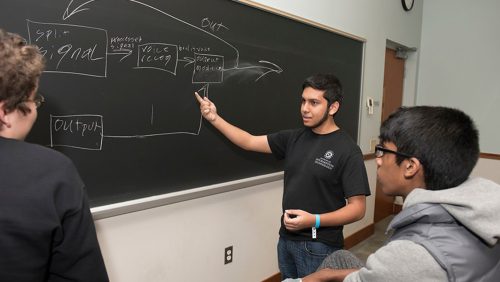
As a student at Johns Hopkins, the nation’s leading research university, you’ll have opportunities that other schools simply cannot offer.
Our collaborative culture and the emphasis we place on the integration of research and education means that as an undergraduate, you’ll have the chance to conduct research and create knowledge, working side-by-side with renowned faculty from across the School of Engineering as well as with researchers and clinicians from the Johns Hopkins Schools of Medicine and Public Health.
Our stellar reputation with employers from across a wide variety of industries and the access you’ll have to our global alumni network translate into excellent with internship and career opportunities for our students.
Undergraduate Research Opportunities
Approximately 40% of computer science undergraduates elect to participate in research. Whether on the Homewood campus, the medical campus, or at the Johns Hopkins University Applied Physics Laboratory, there are so many ways to get involved.
Interested? Here are some suggestions for how to get started:
- Speak to your faculty advisor about your interest in conducting research and talk to other students about their experiences.
- Review the computer science faculty members’ bios and lab pages, identify faculty whose research interests align with yours, and get in touch with them to let them know that you want to participate in their research activities.
- Check out the many Johns Hopkins-sponsored undergraduate research opportunities.
- Explore the Department of Computer Science’s research opportunities for undergraduates:
- The Senior Honors Thesis program (Undergraduate Advising Manual).
- The Pistritto Research Fellowship—this fellowship is an application-based program that provides an annual stipend for students doing research in the area of information visualization. A call for applications is emailed to undergraduates each spring for the upcoming academic year. Fellowship recipients may choose to pursue their research during the summer or during the regular school year and in conjunction with a sponsoring faculty member.
- CS Undergraduate Research Support – students may apply for partial funding support from the CS department when conducting research with a CS faculty member. The faculty member must agree to pay 50% of the support requested. Use this form to apply.
- Masson Fellowship – provides a 25% tuition waiver for combined students (BS/MSE) pursuing research for their Master’s program. A call for applications is emailed to eligible students each spring for the following year. Fellowship recipients may choose to pursue their research under the award during either a fall or spring semester, but they must be full-time.
- Visit the national Computing Research Association’s website for information about undergraduate research programs.
- Check out the NSF listing of summer Research Experiences for Undergraduates (REU) sites.
Not a Hopkins student but want to conduct research with our faculty? Learn more about becoming a visiting undergraduate student here.
Student Spotlight: Jiaqi Yu
The third-year computer science student used her Provost’s Undergraduate Research Award to build an interactive dashboard that allows researchers to visualize microscopic brain activity in real time.

2026 Research Projects
Learn about the amazing research our undergraduates are pursuing this year.
Faculty Research Advisors: Michael Dinitz, Stephen Stone
Abstract: This project addresses questions of counting and construction in music theory. A few initial results are: (a) a combinatorial proof that reinterprets the Stirling numbers of the second kind S(n, k) as the number of length-n forms using k letters, and the Bell numbers B(n) as the number of all length-n musical forms; (b) an extension of traditional serialism to k-gram serialism via the De Bruijn graph; and (c) a simple method that uses matrix exponentiation to count the number of length-n chord progressions under a ruleset such as the tonic-predominant-dominant tonal phrase model or the Kostka and Payne chord progression flowchart. The project then presents an extended inquiry into first species counterpoint. We resolve issues in the existing literature by (d) demonstrating a ruleset-agnostic encoding of first species counterpoint using deterministic finite automata. Using this encoding, we present (e) an O(n) algorithm to verify candidate counterpoints to a given length-n cantus; (f) an O(n) algorithm to count the number of counterpoints to a given length-n cantus; (g) an O(log n) matrix exponentiation algorithm to count the total space of length-n cantus-counterpoint pairs; and (h) a cost-function-agnostic method for finding an optimal counterpoint to a given length-n cantus in O(n^2).
About Alex: Alex Ma is a senior majoring in computer science and music composition. His artistic portfolio is available here, You can also find him on LinkedIn. The research featured above culminated in a CS Honors Thesis, with work supported by a 2025 Summer Provost’s Undergraduate Research Award. Alex is also the winner of a Peabody Community Connectivity Award and a President’s Commendation for Achievement in the Arts for his co-founding and co-presidency of the 5x-grant-and-award-winning New Contemporary Tonality Collective. He was a 2019 National Young Composers Challenge Finalist, recently won a track at the University of Toronto’s UofTHacks13 hackathon, and enjoys humor.
Faculty Research Advisor: Kristina Gligorić
Abstract: Large language models are increasingly used to annotate texts, but their outputs reflect some human perspectives better than others. Existing methods for correcting LLM annotation error assume a single ground truth. However, this assumption fails in subjective tasks where disagreement across demographic groups is meaningful. Here, we introduce perspective-driven inference, a method that treats the distribution of annotations across groups as the quantity of interest and estimates it using a small human annotation budget. We contribute an adaptive sampling strategy that concentrates human annotation effort on groups where LLM proxies are least accurate. We evaluate on politeness and offensiveness rating tasks, showing targeted improvements for harder-to-model demographic groups relative to uniform sampling baselines, while maintaining coverage.
About Navya: Navya Mehrotra is a rising junior studying computer science and economics. This summer, she is conducting AI alignment research in the BDP Summer Program with Gillian Hadfield. Previously, Navya worked on causal inference with Paul Ferraro and disease modeling with Anton Dahbura, Kimia Ghobadi, and the World Health Organization. She is the incoming president of JHU Women in Computer Science and vice president of HopAI. Navya is interested in problems that sit across disciplines—combining CS, economics, and statistics to build applications that create real-world impact.
Faculty Research Advisor: Ben Langmead
Abstract: In metagenomics, scientists study DNA sequences obtained from environmental samples such as soil, water, or the human gut microbiome. It is then important to determine which species each DNA sequence most likely comes from, which is a task known as taxonomic classification. In our research, we developed a software tool that can index datasets containing tens of thousands of genomes and perform highly efficient and accurate taxonomic classification on DNA sequences. The tool builds on the move structure and augments it with a new type of “color” information and string-matching algorithms to support classification. We hope this work helps researchers accelerate progress in metagenomics, which is critical for studying biodiversity, monitoring ecosystems, and discovering novel species.
Faculty Research Advisor: Anton Dahbura
Abstract: Across thousands of ski areas around the world, lift loading and unloading areas are fast-moving environments where a few seconds can make a meaningful difference in skier safety. This project designs and validates a vision-based monitoring system that assists lift operators by automatically identifying dangerous loading/unloading scenarios in real time. The pipeline detects and tracks individual skiers from a video stream, utilizes an occlusion-agnostic method to estimate their body pose, and classifies skeleton-based motion sequences into normal or hazardous scenarios (such as falls and late loading). Rather than replacing human operators, the system is designed as a human-in-the-loop safety co-pilot: It produces risk scores and warning overlays that help draw operators’ attention to incidents as they begin to develop. Across multiple viewing angles and incident types in validation, the prototype achieved strong classification performance (96.88% classification accuracy with out-of-distribution scenes) and generated warning signals 3.24 seconds ahead of human response on average. These results offer a strong proof of concept for applying computer vision to repetitive, time-sensitive lift monitoring environments, and may inform future real-world commercial deployments.
About Kevin: Kevin Wu recently graduated from the Johns Hopkins University with a combined BS/MSE in computer science and a minor in entrepreneurship and management. Spanning surgical robotics and computer vision, his research won him the Department of Computer 2025-2026 Masson Fellowship. His work has been published at major venues including the IEEE International Conference on Robotics and Automation and has been featured by media outlets including CBS News. Over the past three years, Kevin has also served as a teaching and course assistant for multiple courses at the Whiting School of Engineering, and additionally as a peer leader in the A. James Clark Scholars Program. Outside of campus, he enjoys skiing, surfing, and powersports. Following graduation, he will be joining a stealth startup in San Francisco.
Student Spotlight: 2026 BDP Summer Fellows
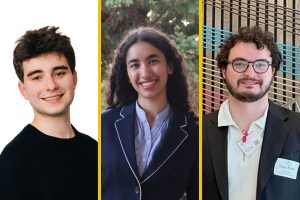
Malcolm Krolick, Navya Mehrotra, and Kaan Eroltu were awarded BDP Summer Fellowships this year. The Bloomberg Distinguished Professorships Summer Fellowship Program gives Johns Hopkins undergraduates the opportunity to work and conduct research under the mentorship of some of the world’s preeminent scholars.
Prior Research
Learn more about previous years’ undergraduate research.