
Inspired by their own runs on the university’s track and cross country teams, Johns Hopkins seniors Mirra Klimov and Matthew Kelly have developed a free marathon pacing tool that runners around the world can use to get a competitive edge in the upcoming Abbott World Marathon Majors.
Available to all, the tool features personalized recommendations for pacing each portion of a race based on a user’s personal running style, data from past marathon finishers, and elevation changes—plus maps, advice, and locations of water stations and turns for each interval of a particular course.
“We began this project with the 2025 Sydney Marathon,” explains Klimov. “It was added last year to the Abbot World Majors—previously a series of six of the world’s largest and most prestigious marathons in Tokyo, Boston, London, Berlin, Chicago, and New York City—creating a great influx of new runners unsure how to pace the course.”
Unlike other pacing apps on the market, the group’s tool utilizes each marathon’s unique elevation profile to calculate splits, or the time taken to complete a specific segment of a race, plus tens of thousands of runners’ race results from past races. The tool also provides visuals of each race segment with a mile by mile (or kilometer by kilometer) breakdown, a notecard of helpful information about the course, and the option to export a runner’s personalized strategy as a pace band—a wristband that lists target times to help marathoners maintain a specific pace and achieve a particular finish time.
“There is no tool that does everything that our tool does—and especially none that do it for free!” Klimov says.
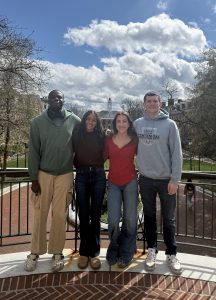
From left to right: Development team members Lamine Niang, Sahana Sanjeev, Mirra Klimov, and Radomyr Couture.
Since the beginning of the school year, the development team has grown to include computer science majors Radomyr Couture, Sahana Sanjeev, and Lamine Niang, all members of the Johns Hopkins Sports Analytics Research Group. The students are advised by Anton Dahbura, the research group’s director, and alumnus Tad Berkery, Engr ’24 (BS/MSE), now a research program coordinator for the group.
The team has also greatly expanded its tool, accommodating additional marathons including Tokyo, New York City, Boston, and London, as well as including detailed data on its methodology and helpful insights from past marathons, such as how each pacing strategy performed, challenges the marathoners faced in terms of weather or terrain, and improvements made on the course as compared to previous years.
To gauge interest with runners in the international marathoning community, the team solicited feedback from Facebook groups and Reddit threads dedicated to preparing for the upcoming Abbott World Majors—which is how they connected with Australian runner Alexis Dean, who used their tool for the 2025 Sydney Marathon, her fifth marathon ever.

Alexis Dean in the Sydney Marathon.
“When I was preparing, I found it challenging to come up with my own pacing plan because of the hilly course—especially using kilometer splits—so the tool was very helpful,” she says. “I liked that you could choose different pacing strategies and I ran through a few different options to see which I felt most comfortable with.”
Dean began the race confident of the pace she wanted to run for each part of the race, and achieved a time of 3:08:47—13 seconds under her goal of 3:09, landing her in the top 1% of all women finishers in that marathon.
“I was so happy and proud, and the pacing tool definitely contributed to this result!” she says.
Her time qualified her for the 2026 Boston Marathon, taking place Monday, April 20. Dean plans to use the tool’s new Boston pacing module to help her prepare: “Boston is another hilly course and I’m not familiar with it at all. I’m aiming for under 3 hours, so I’ll need all the help I can get and a strong pacing strategy!”
The tool is live for runners to plan their personalized racing strategy for this month’s Boston and London marathons, and the students will present their work at the annual Johns Hopkins Engineering Design Day on April 28.