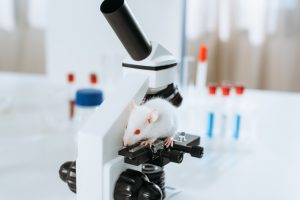
Studying brain conditions like strokes and tumors typically requires MRI scans, which force test subjects to be anesthetized or immobilized to get clear images. This makes it difficult to see how diseases such as Alzheimer’s affect the brain while a subject is awake and moving around.
To address this problem, researchers in the Pathak Lab at the Johns Hopkins School of Medicine have built a mini microscope, or “miniscope,” that they can attach directly to a mouse’s brain; resembling a little hat, the scope is so small that the mouse can move around freely for hours—all while the researchers watch its brain activity in real time.
Using her Provost’s Undergraduate Research Award, third-year computer science student Jiaqi Yu is helping advance this effort by building a live dashboard to process data collected by the miniscope in real time, streaming interactive maps of cerebral blood flow, neuronal activity, and oxygen saturation to her fellow researchers instantly, no matter where they are.

Jiaqi Yu
Yu joined the Pathak Lab through SMILE, a platform that connects current students to paid campus internships and employment opportunities across Johns Hopkins. She came up with the idea for this project when she noticed that her lab mates, predominantly biology majors, were struggling with coding while they tested the miniscope.
“The code was about four times longer than it needed to be,” Yu says. “Also, we usually run really long experiments—some lasting 24 hours. When they were finished, I saw my teammates having to search through a hundred terabytes of data, so I asked, ‘What if I could shorten this process and make their lives easier by building a dashboard for them to watch the miniscope in real time?'”
Yu says taking Data Structures and Algorithms with Associate Teaching Professor Patricio Simari helped her improve the existing code’s efficiency.
“As for building the user interface and the website—plus increasing the speed of the image transfer and server communications—I’m using a lot of what I learned in Full-Stack Javascript, which I took with Ali Madooei,” she says. “Even though it’s mainly a UI class, Professor Madooei taught us a lot about how to make our websites more efficient.”
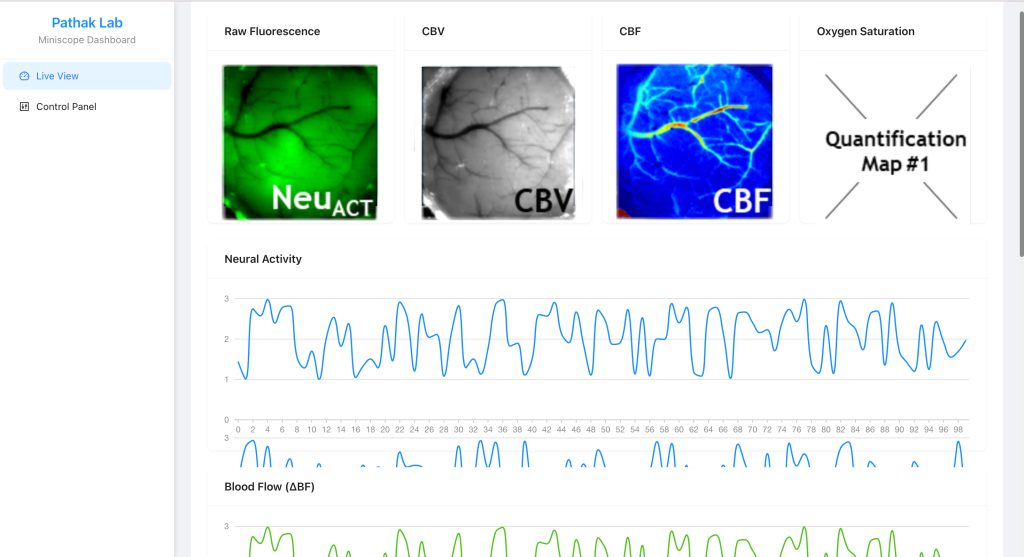
The live dashboard interface.
Originally, the researchers had to enter their lab, grab the USB stick attached to the miniscope, and plug it into their computers to access their data. But with Yu’s dashboard, they can now control and view the different miniscope channels live, perform real-time data analysis and graphing, and download crucial images almost instantly.
“I think what really drives me in this project is actually the part I’m not that good at: computational biology,” Yu says. “I want to look more into how our researchers actually get their metrics from the miniscope images and make that real-time, too, which will be a great challenge.”
In the future, she wants to explore using deep learning and machine learning techniques to predict future trends based on current data.
“Ultimately, I want this dashboard to help our scientists spot anomalies immediately, shorten their analysis time, and enable global collaboration on long‑term brain‑disease studies,” Yu says.
Provost Joseph Cooper established the PURA program in 1993 with an endowment by the Hodson Trust to support and encourage Hopkins undergraduate students to engage in independent research, scholarly, and creative projects.