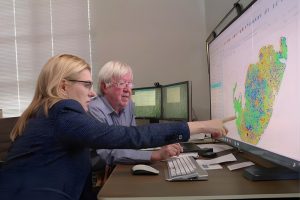
At Johns Hopkins, the future of cancer research is unfolding through the revolutionary use of AI and vast datasets. Researchers Alex Szalay and Janis Taube are pioneering the AstroPath platform, drawing on techniques from astronomy to meticulously map tumor-immune cell interactions in unprecedented detail. While traditional methods were labor-intensive, AI accelerates this process, creating AI-ready data that holds promise for personalized immunotherapy. As the duo emphasizes, tapping into this treasure trove of data could unlock breakthroughs in cancer treatment, enabling more patients to benefit from therapies and leading the charge in the fight against cancer. With adequate funding and innovation, Johns Hopkins aims to drive these discoveries from the lab to the clinic, paving the way for a new era in cancer medicine.
When it comes to harnessing AI for cancer breakthroughs, Johns Hopkins researchers Alex Szalay and Janis Taube believe the future begins with data—lots of it. In fact, Szalay points out that one of the greatest challenges is not too much data, but too little. While efforts are underway to securely digitize pathology slides, images, and other patient information, AI tools are advancing even faster. Their potential is limited only by the amount of data available to explore—data that can help uncover new answers to complex questions about cancer. Just a few years ago, managing and interpreting the billions of data points generated by genetic sequencing and other cancer research was a barrier to cancer discovery, but today, it is part of the solution. Szalay, the Bloomberg Distinguished Professor of Big Data and the director of the Institute for Data-Intensive Engineering in Science at the Johns Hopkins University and its Whiting School of Engineering, gained renown for his ability to manage enormous astronomy data sets. Now, he is turning that expertise toward cancer.
Astronomy to microscopy
The Johns Hopkins astrophysicist worked with Taube to build the AstroPath platform using the same infrastructure that was used for the Sloan Digital Sky Survey, which mapped the universe. The science that allowed his sky survey to “stitch” together billions of telescopic images of celestial objects—each expressing distinct light signatures—to quantify the statistical properties and spatial arrangement of stars and galaxies in the universe also allowed them to create a similarly detailed view of how and where tumor cells interact with surrounding cells, particularly immune cells.
Just as the Sloan survey mapped the cosmos on an astronomical scale, Taube, the director of the Divison of Dermatopathology and a co-director of both the Bloomberg~Kimmel Institute’s tumor microenvironmentpProgram and the Mark Foundation Center for Advanced Genomics and Imaging, says AstroPath is able to map the tumor microenvironment on a microscopic scale.
Now, working together at the intersection of physics, computer science, pathology, and cancer immunotherapy, they are accelerating the way discoveries move from lab to clinic by creating massive, high-quality cancer data sets—the essential building blocks for AI.
“Modern computing has been taken over by AI,” says Szalay. “The key is data. Google and others can build powerful algorithms, but they don’t generate the data that science needs. That is where universities, and places like Hopkins, can lead.”
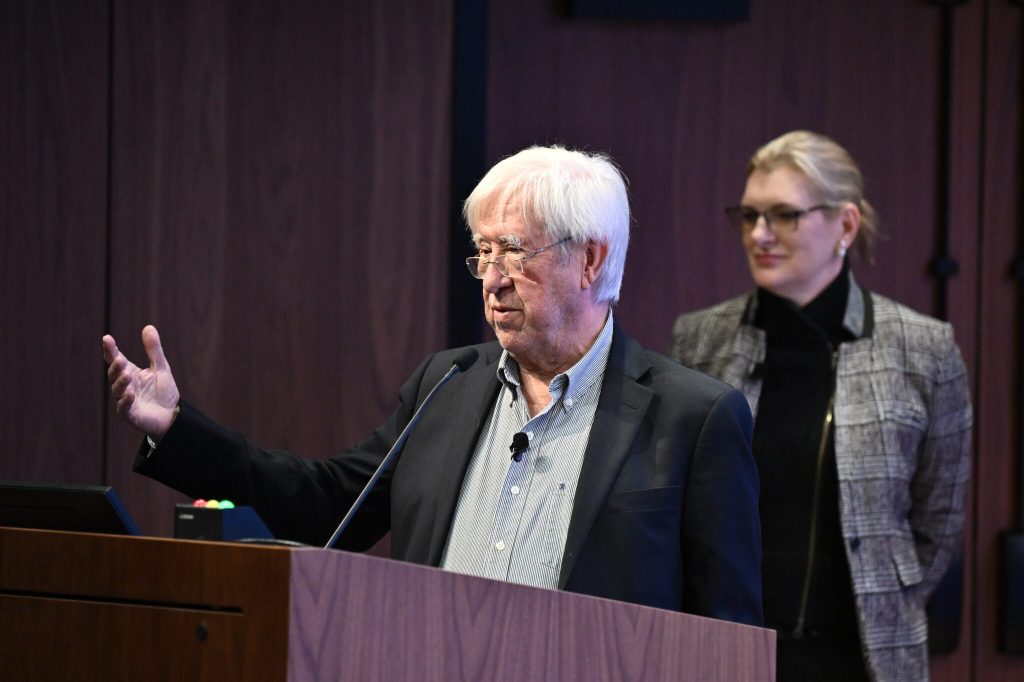
Alex Szalay and Janis Taube
Geography of tumors
Taube and Szalay began their AstroPath work with a project to map the geography of the interplay between tumor and immune cells in melanoma. Taube recalls how labor-intensive it was, drawing tumor boundaries by hand on slides and annotating each image. Today, AI is doing that work in minutes, with greater precision, she says.
“These are supervised tools,” says Taube. “We still oversee the process, but AI allows us to generate data sets much faster and with far more detail than we could by hand.”
The result is a new generation of “AI-ready” data—digitized slides enriched with spatial maps showing where all the cells that influence cancer are located and how they interact. These maps are proving vital in the search for predictive biomarkers of immunotherapy response.
“We are using AI to build the data sets that can be queried by deep-learning algorithms to aid in the depth and speed of cancer research,” says Taube.
The tool is transforming how oncologists deliver cancer immunotherapy, revealing what geographic interactions are transpiring and what interactions are responsible for inhibiting immune cells from killing cancer cells.
“Across all solid tumor types, only about 30% of patients currently benefit from immunotherapies, but by combining spatial mapping with genomic and molecular data, we believe we can begin to uncover how more patients can be helped,” she says.
Investing in the future
Building these data sets is not cheap. Staining and analyzing a single specimen can cost around $1,000. But Taube and Szalay see this as a small investment compared with the $150,000 price tag of some cancer drugs.
“If we can identify the right patients for the right drugs, the cost savings, and most importantly, the patient benefit, are enormous,” says Taube. “This is how we reduce side effects, avoid financial harm, and expand the number of patients who respond.”
Szalay adds that Johns Hopkins is well-positioned to lead. Decades of expertise in handling “big data” from astronomy and other sciences, he says, now meets a medical school brimming with students like Charles Lu, equally comfortable in AI and medicine. Lu is working with Taube and Szalay, using AI to build highly detailed images of the boundary between tumor cells and surrounding normal tissue, as well as the molecular markers that the tumor and immune cells display at this interface.
“It’s exciting to see in Charles the next generation of researchers,” Szalay says. “They are as much at home in AI techniques as in biology, and they are bringing fresh energy and ideas.”
A spatial revolution
Taube calls this moment a “spatial revolution.” Her team is applying AI to the Cancer Genome Atlas melanoma slides—data already de-identified and publicly available—to create AstroPath maps that link melanoma cell geography to genomic profiles. She plans to create similar maps with Johns Hopkins’ own cancer data sets.
To manage this responsibly, Taube, Szalay, and team developed AstroID, a de-identification system that allows researchers to securely track patients across multiple visits, biopsies, and scans without compromising privacy.
“This is not a technical problem,” says Szalay. “We know how to do this safely. What’s needed is the intellectual energy, an attention to the ethical framework, and the support to scale it.”
A treasure trove
For Szalay and Taube, the urgency is clear. They believe that, with sufficient funding, they could take their proof-of-concept studies to large-scale production within a year.
“This is the tip of the iceberg,” says Szalay. “By letting AI take over routine tasks, just as we now trust it to guide our cars, we can hand it the microscopes, too—freeing scientists to focus on discovery. These smarter, faster experiments will lead to the next generation of drugs and clinical trials.”At institutions around the world, scientists are grappling with these issues to figure out how best to use AI to harness big data and accelerate discovery.
“At Johns Hopkins, we are probably one step ahead. Astronomy, fluid dynamics, ocean circulation models, you name it—Hopkins scientists have decades of experience and are incredibly competitive. Now, that expertise—combined with the strength of the School of Engineering and collaborations across Johns Hopkins Medicine—is being turned toward cancer,” says Szalay. “We are sitting on a treasure trove, and we want to move quickly so we can identify more causes of cancer, discover new treatments, and save lives.”
This article originally appeared on the Sidney Kimmel Comprehensive Cancer Center website »