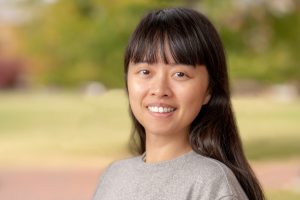
Zih-Yun “Sarah” Chiu joins the Johns Hopkins University as an assistant professor of computer science and a member of the Data Science and AI Institute. She obtained a PhD in electrical and computer engineering from the University of California, San Diego.
Tell us a little bit about your research.
My group focuses on bringing guarantees and intelligence to robotic surgical systems. Surgical robots have played an essential role in robot-assisted minimally invasive surgery, leading to faster recovery time and improved patient outcomes. These robots also open the door to surgical autonomy, a future trend that could address the projected shortage of surgeons and democratize high-quality surgical treatment. For autonomous robots to be trusted with matters of life or death, their effectiveness, efficiency, safety, and generalizability must demonstrably match that of human expert surgeons.
Our research studies how desirable outcomes can be probabilistically or asymptotically guaranteed in autonomous surgery from the perspectives of robot sensing, planning, motion, and adaptation. Specifically, we aim for surgical robots to achieve clinically translatable performance in environment understanding, motion generation, and rapid generalization across patients, despite the challenges of sensor noise, the complexity of human biomechanics, and anatomical variability.
Tell us about a project you are excited about.
Surgical excellence is built on years of deliberate practice and continual learning. For a surgical robot, “practice” may be done by going through a large amount of data. However, the capability for continual learning in surgical robots remains largely unrealized. In the most efficient way, how can a robot never stop acquiring new skills and use them to solve new tasks?
We look into this by proposing an efficient way for surgical robots to observe, learn, accumulate, and apply new skills. We believe one of the keys to continual learning is the flexibility of how knowledge can be acquired and accumulated, asking, “Can we leverage knowledge in any form, with any relevance to a task, and in a dynamic way?” In our recently published paper, we introduce an incremental reinforcement learning algorithm that continuously leverages an arbitrary, dynamic set of knowledge to solve unseen tasks efficiently. This work excites me because it is our first attempt toward surgical robots with lifelong learning capabilities.
Why this? What drives your passion for your field?
Ever since I watched the movie Real Steel, I have always wanted to work in robotics—yet I never thought I would work in surgical robotics because I couldn’t stand the sight of blood. (I can now, thanks to all the surgical videos I’ve watched over the past few years!)
My first research project during my graduate studies was about automating a surgical subtask using the da Vinci Research Kit (dVRK). I was fascinated by the robot the first time I saw it move—the design and its precision blew my mind. I truly enjoyed working with the robot, even when it was in a bad mood and causing me some trouble. But perhaps more importantly, I believe surgical robots, when imparted with some level of autonomy and intelligence, can help more people receive high-quality surgical treatment and reduce surgeons’ workload. Deep down, this is very meaningful to me, as I realized that, unexpectedly, the stories my dad (a surgeon before he retired) told me have had a great influence on my vision of how technology will benefit our society.
What classes are you teaching?
I teach Reinforcement Learning in the fall, and I will teach a new course, Introduction to Robot Learning, in Spring 2027. In this course, we will cover how AI/ML has advanced robotics across areas such as robot vision, decision-making, planning, control, and sim-to-real transfer. The goal is to gain a broad understanding of the field and develop fundamental knowledge for future in-depth study. Another emphasis of this course will be the discussion of history, trends, and future directions, as well as the necessity of data-driven approaches in different aspects of robotics.
Why are you excited to be joining the Johns Hopkins Department of Computer Science?
Johns Hopkins has a perfect environment for surgical robotics research. I had been following Hopkins’ research long before I joined, and JHU is one of the leading institutions that developed my best robot buddy, the dVRK. Just as I thought I couldn’t be more impressed, I visited the Department of Computer Science and was even more amazed by the passion of the people here for their research and by how cool the collaborative robot space is! At Hopkins, I am always surrounded by researchers, clinicians, and students with insightful and visionary perspectives on healthcare and robotics. In addition, it’s exciting to see the university’s investment in AI and its potential in various fields. I am lucky to join CS@JHU at this crucial moment and witness the rapid evolution of intelligent robotic surgical systems.
Besides your work, what are some of your other hobbies and passions?
I love reading books, especially classics, fiction, and biographies. My favorite books are Pride and Prejudice, A Thousand Splendid Suns, Demon Copperhead, and Steve Jobs. I also enjoy casual hiking—It has to be really casual!—and trying out new sports. And although I don’t have much time to practice, I play piano in my spare time.