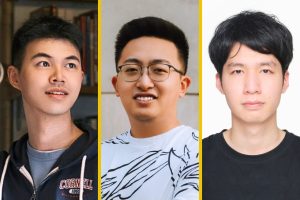
The Johns Hopkins University is one of nine universities selected by Amazon for its new AI PhD Fellowship program, an initiative that will provide nearly $68 million in funding over two years to more than 100 doctoral students nationwide.
In its inaugural year, the program will support seven Whiting School of Engineering doctoral students studying core AI topics in areas including machine learning, computer vision, and natural language processing. Additionally, three new Amazon-funded Whiting School fellows were announced through the JHU + Amazon Initiative for Interactive AI (AI2AI).
The AI PhD Fellows, chosen based on their proposals for research projects that have the potential for significant societal impact, receive tuition, a stipend, fees, a travel grant, and mentorship from Amazon scientists, along with Amazon Web Services cloud-computing credits to support their computational research.
Each fellow is matched with an Amazon research liaison—a senior scientist whose expertise aligns with their work. This mentorship is essential to the program’s success, according to Whiting School Dean Ed Schlesinger.
“The funding will enable our students to explore topics that are at the cutting edge of their areas of inquiry, but it is through mentorship that they’ll learn how to transform their groundbreaking ideas into deployable systems that can enhance people’s lives,” Schlesinger says.
Rohit Prasad, senior vice president and head scientist in Amazon’s Artificial General Intelligence, says he views collaborating with the some of the brightest PhD students at the nation’s leading research universities as a big win for Amazon.
“What makes this program special is how it brings together Amazon’s real-world experience across diverse industries with the fresh perspectives of these top researchers to cultivate the next generation of AI leaders,” Prasad says.
The first cohort of Johns Hopkins AI PhD Fellows includes two doctoral candidates from the Department of Computer Science.
Chuanyang Jin aims to develop AI systems with advanced social intelligence that can learn and coexist with humans. “Social intelligence isn’t just a theoretical ideal in cognitive science,” he says. “It is a practical necessity. These capabilities are essential for AI systems to operate safely and productively alongside people in ever-changing contexts.”
Advised by Tianmin Shu, Jin is currently creating AI that can reason about, learn from, and adapt to humans. He has received an Outstanding Paper Award at the 2024 Meeting of the Association for Computational Linguistics, the International Consortium for Mathematics and its Applications Scholarship Award, and the Computer Science Prize for the Most Promising Student at New York University.
Jingyu “Jack” Zhang explores natural language processing with a focus on foundational model safety and alignment. He conducts his research on pluralistic alignment, verifiable LLMs, and renewable evaluation benchmarks for safety in the Center for Language and Speech Processing, where he is advised by Daniel Khashabi and Benjamin Van Durme.
This initiative builds on Amazon’s history of supporting academic research at Johns Hopkins and complements AI2AI, which since 2022 has provided funding for faculty research and 17 doctoral fellows in machine learning, computer vision, natural language understanding, and speech processing.
Computer science PhD candidate Yiqing Shen was named one of this year’s AI2AI Fellows. He develops visual foundation models aimed at understanding and interpreting visual information for applications across various fields. Prior to his doctoral studies, Shen earned his BS in mathematics and applied mathematics from Shanghai Jiao Tong University.
In addition to the Johns Hopkins University, the other participating universities are Carnegie Mellon University; the Massachusetts Institute of Technology; Stanford University; the University of California, Berkeley; the University of California, Los Angeles; the University of Texas at Austin; the University of Illinois Urbana-Champaign; and the University of Washington.