Our researchers are defining the future of how machines perceive, interpret, and interact with the visual world; our work bridges foundational principles of scene understanding with cutting-edge advancements in 3D vision, visual generative models, embodied AI, computational photography, multimodal reasoning, and physics-informed learning.
Additionally, our graphics and augmented and virtual reality (AR/VR) research aims to advance the science and engineering of immersive computing with a focus on creating, experiencing, and interacting with digital worlds. We work on rendering, 3D modeling, simulation, and AR/VR systems.
Our faculty and students work in a highly collaborative environment to solve problems in robotics, medicine, graphics, and human-computer interaction. This interdisciplinary work is amplified through close collaborations with groups like the Laboratory for Computational Sensing and Robotics, the Center for Language and Speech Processing, the Malone Center for Engineering in Healthcare, and the Data Science and AI Institute—as well as with faculty from the Department of Cognitive Science and the School of Medicine.
Research Groups and Labs
Advanced Robotics and Computationally AugmenteD Environments Lab
The ARCADE Lab develops collaborative intelligent systems that support clinical workflows to increase access to—and expand the possibilities of—highest-quality healthcare. In designing these systems, they pioneer human-centered solutions that are enabled by synergistic advancements across imaging, computer vision, machine learning, and interaction design and that are embodied in emerging technology such as mixed reality and robotics.
Computer Graphics Group
The Johns Hopkins Computer Graphics Group investigates shape retrieval, symmetry detection, surface reconstruction, mesh editing, and image processing.
Computational Interaction and Robotics Lab
CIRL researchers are interested in understanding problems that involve dynamic, spatial interaction at the intersection of vision, robotics, and human-computer interaction.
Computational Cognition, Vision, and Learning Research Group
The CCVL research group’s goal is to develop mathematical models of vision and cognition to design artificial (computer) vision systems.
Computer Integrated Interventional Systems Laboratory
The CIIS Lab exists to develop surgical systems that integrate novel computer and human/machine interface technologies that will revolutionize surgical procedures, extending surgeons’ abilities to achieve better outcomes at lower costs.
Sci-Phy Lab
The Sci-Phy Lab studies the science of physical agents—intelligent systems that perceive, reason, and act in the physical world—to uncover the general principles that enable robots to move, manipulate, and interact seamlessly with objects, people, and other physical agents.
Social Cognitive AI Lab
Working at the intersection of embodied AI, machine learning, and computational social cognition, SCAI’s goal is to advance human-centered AI by engineering machine social intelligence to build socially intelligent systems that can understand, reason about, and interact with humans in real-world settings.
People
-
 Email:homanga@jhu.edu
-
 Email:bhattad@jhu.edu
-
 Email:jaemin@jhu.edu
-
Gregory D. Hager
Mandell Bellmore Professor Email:hager@jhu.eduPhone:410-516-5521
-
 Email:kmj@jhu.edu
-
Email:mkazhda1@jhu.eduPhone:410-516-0060

-
 Email:tianmin.shu@jhu.edu
-
Russell Taylor
John C. Malone Professor Email:rht@jhu.eduPhone:410-516-4639
-
 Email:mathias@jhu.eduPhone:410-516-4253
-
 Email:ayuille1@jhu.eduPhone:410-516-5331
-
 Email:zzhou82@jh.eduPhone:480-738-2575
Rama Chellappa

Ralph Etienne-Cummings




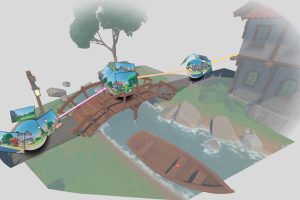
AI system can envision an entire world from a single picture
An AI model created by Johns Hopkins computer scientists imagines in-depth scenarios based on a single image to make informed decisions about the world.