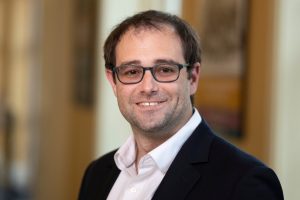
A research team led by Alex Marder, an assistant professor of computer science, has been awarded a research grant through the Cohen Translational Engineering Fund.
The fund was made possible by a generous commitment from Sherry and Neil Cohen, Engr ’83, the founder and chairman of venture capital firm Emerald Development Managers. It serves as a catalyst for translating cutting-edge research into practice by providing faculty with critical early funding.
This grant is designed to help researchers further develop and characterize their technology with a focus on commercial application by conducting key experiments to de-risk the innovation, collecting data that will bolster patent applications, working with contract research organizations to accomplish discrete deliverables, building prototypes, and more. Grantees receive a maximum of $100,000 for a nine-month project.
Since its inception a decade ago, the Cohen Fund has awarded more than $1.7 million to support 33 projects. Prior winning projects include a novel gene therapy that reprograms solid tumor cells via biodegradable polymers to trigger an anti-tumor immune response in the body, as well as a lens-free holographic device for imaging urine that has enabled the early detection of urinary tract infections.
A panel of experienced researchers, engineers, startup entrepreneurs, and business executives reviewed presentations from a highly competitive pool of selected faculty finalists. Marder’s project, “Real-Time Evaluation and Verification of External Adversarial Links” is one of two selected to receive a grant this year.
Nation-state adversaries can eavesdrop on sensitive cellular communications around the world through the cellular radio infrastructure housed on LTE and 5G cellular towers, also known as base stations. To counter this, Marder and his team have created a classifier technology that identifies the manufacturers of radios on nearby cell towers by analyzing received radio frequency transmissions. This capability helps distinguish between base stations made by benign vendors and those that are potentially malicious.
Enabling secure identification offers a communications advantage to the U.S. Department of Defense and the State Department. Currently, military members and diplomats are advised against using cell phones for sensitive communications, unfortunately limiting access to the high-bandwidth and low-latency communications of cellular networks.
Marder envisions two products resulting from this technology, the first being an app that notifies a user of the base station their phone is connected to and automatically reconfigures the phone to connect to a safe base station if a malicious one is identified. The second product is a database of station observation and classification data, annotated with geolocations and vendors based on what the app observes; this database would allow for an analysis of which overseas cell carriers use safe base station infrastructure in specific areas of interest.
The team plans to use its grant funding to transition its existing prototypes into production-ready software. This process will include improving the user interface of the database, increasing the reliability of the phone application, and hardening the security of both products against potential attack.
Excerpted from the Johns Hopkins Technology Ventures website >>