
Six CS faculty members and their collaborative research teams have been chosen to receive 2025 Johns Hopkins Discovery Awards. Chosen from 274 proposals, Jason Eisner, Gillian Hadfield, Daniel Khashabi, Tom Lippincott, Benjamin Van Durme and Ziang Xiao are among 150 individuals on the 39 multidisciplinary endeavors that have been selected to receive support this year.
The Discovery Awards program was announced in early 2015, as was the Catalyst Awards program for early-career researchers. Together the two programs represent an $85 million university commitment by university leadership, along with the deans and directors of JHU’s divisions, to faculty-led research.
The Discovery Awards are intended to spark new interactions among investigators across the university rather than to support established projects. Teams can apply for up to $150,000 to explore a new area of collaborative work with special emphasis on preparing for an externally funded large-scale grant or cooperative agreement.
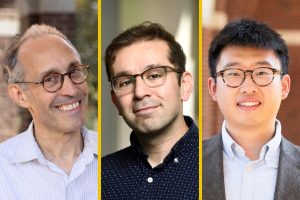
Jason Eisner, Daniel Khashabi, and Ziang Xiao.
Eisner’s research goal is to develop probabilistic modeling, inference, and learning techniques that can model all kinds of linguistic structure and can connect existing models to common-sense reasoning, formal reasoning, and downstream user interfaces; Khashabi’s work focuses on the computational foundations of intelligent behavior within various mediums of communication, particularly natural language; and the goal of Xiao’s research is to enhance human-AI interaction to expand our knowledge of ourselves. Together—along with Andrew Perrin, a professor of sociology in the Krieger School of Arts and Sciences—they will explore “Using AI to Make Social Media More Prosocial.”

Gillian Hadfield, Benjamin Van Durme, and Daniel Khashabi.
Hadfield’s research is focused on innovative design for legal and regulatory systems for AI and other complex global technologies, computational models of human normative systems, and working with machine learning researchers to build systems that understand and respond to human values and norms, while Van Durme’s work focuses on helping people work with large amounts of information by understanding what information is present in documents and images, helping people find that information, and being able to help answer questions about that content. Joined by Khashabi and Mahyar Fazlyab, an assistant professor of electrical and computer engineering, they will research “Control-Theoretic Inference-Time Value Alignment.”
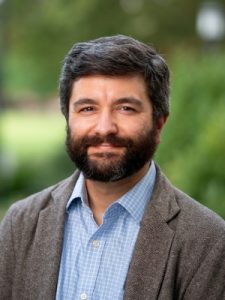
Tom Lippincott.
Lippincott’s research focuses on how machine learning can support and facilitate traditional scholarship in the humanities, particularly the use of unsupervised models structured for interpretability and isomorphism with respect to a domain of interest. He will work on “Causal Reasoning and Memory in Humans and Language Models: A Flash Fiction Contest in Baltimore City” with Krieger School faculty Janice Chen, Dora Malech, and Hale Sirin, as well as Daniel Princiotta, an assistant research scientist in the Johns Hopkins University School of Education.