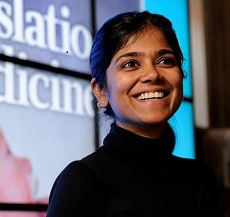
Assistant Professor
Johns Hopkins University
Department of Computer Science
Department of Health Policy & Management
Other Affiliations: Institute for Computational Medicine, Laboratory for Computational Sensing and Robotics, Armstrong Institute for Patient Safey and Quality,
Center for Population Health Information Technology, and Center for Language and Speech Processing
Brief Bio: My interests span machine learning, computational statistics, and its applications
to domains where one has to draw inferences from observing a complex, real-world system evolve. In the last seven years, I have been particularly drawn to
problems that involve modeling data from sensing platforms and electronic health records, as I think these present a tremendous opportunity for high impact work.
See my recent article on this topic.
Prior to joining Johns Hopkins, I did my PhD at Stanford with Dr. Daphne Koller. I also spent a year at Harvard University collaborating with Dr. Ken Mandl and Dr. Zak Kohane as
an NSF Computing Innovation Fellow. While in the valley, I also spent time as an early employee at Aster Data Systems, a big data startup acquired by Teradata. I am an investor
and informal advisor to Patient Ping.
I'm originally from Darjeeling, India. I can be bribed with good tea.
Selected Honors, Awards and Notable Events:
| 2014 |
National Science Foundation Smart and Connected Health Research Grant award for developing computational models for prediction in complex, chronic conditions. More here. Open positions at the PhD, Postdoc and Research Scientist level related to: Bayesian models for Prediction from Noisy, Sparsely-sampled, High-dimensional time series data; Mining Clinical Time Series. |
| 2014 | Google Research Award for developing machine learning tools for extracting information from electronic health records. More here. |
| 2013 | Betty and Gordon Moore Foundation Research award on building safer ICUs. More here. |
| 2011 | National Science Foundation Computing Innovation Fellowship; 17 awarded nationally. |
| 2010 | Science Transtional Medicine Cover article. More here and here. |
| 2010 | American Medical Informatics Association Best Paper Finalist for work on automated annotation of outcomes from electronic health record data. |
| 2007 | Uncertainty in Artificial Intelligence Best Student Paper for work on inference for continuous time discrete space models. |
| 2004 | Rambus Fellowship awarded for 3 years. |
| 2002 | Microsoft Full Scholarship. More here. |
Selected Publications: (ML=Machine Learning, HI=Health Informatics)
[Perspective] S. Saria. A $3 Trillion Challenge to Computational Scientists: Transforming Healthcare Delivery, August 2014. IEEE Intelligent Systems. Vol. 29, Issue 4. Link (Invited article)
[Perspective] D.W. Bates, S. Saria, L. Ohno-Machado, A. Shah, G. Escobar. Big data in health care: using analytics to identify and manage high-risk and high-cost patients, July 2014. Health Affairs. Vol. 33, Issue 7. Link (Watch the presentations made to an audience of policy makers and Congress staffers here.)
[ML] S. Saria, D. Koller, A. Penn. Discovering shared and individual latent structure in multiple time series arXiv:1008.2028, August 2010.
short, long
[ML] S. Saria, U. Nodelman, D. Koller. Reasoning at the Right Time Granularity.
Uncerainty in Artificial Intelligence (UAI), July 2007.
pdf (Best student paper award)
[ML] S. Saria, A. Duchi, D. Koller. Learning Deformable Motifs in Continuous Time Series data. International Joint Conference on
Artificial Intelligence (IJCAI), 2011. pdf
[HI] S. Saria, A. Rajani, J. Gould, D. Koller, A. Penn. Integration of Early Physiological Responses Predicts Later Illness Severity in Preterm Infants. Science Translational Medicine,
September 2010. Vol. 2, Issue 48. Link (Cover article)
[HI] C. Paxton, A. Niculescu-Mizil, S. Saria. Developing Predictive Algorithms Using Electronic Medical Records: Challenges and Pitfalls. American Medical Informatics Association, 2013. pdf
Group:
Andy Jinhua Ma (Postdoctoral Fellow)
Kirill Dyagilev (Postdoctoral Fellow)
Peter Schulam (PhD student; Computer Science)
Katie Henry (PhD student; Computer Science)
Yueling Loh (PhD student; Applied Math and Statistics; Primary advisor: Daniel Robinson)
Andong Zhan (PhD student; Computer Science; Primary advisor: Andreas Terzis)
Ethan Pronovost (St. Paul's High School)
Mu-Hsin Wei (2013-2014; Data Science @ Bloomberg)
Gunnar Atli Sigurdsson (2013-2014; PhD student @ Carnegie Mellon)
Chris Paxton (2012-2013; PhD student @ Johns Hopkins)
Zhou Ye (2013-2014; PhD student @ UCI)
Antonia Oprescu (Summer 2014; Undergraduate @ Harvard)
Phillip Oh (Summer 2014; Undergraduate @ Johns Hopkins)
Riashat Islam (Summer 2014; Undergraduate @ UCL)
Other Notable Recent Events:
- Student news: Peter Schulam wins the Centennial Fellowship (August 2013). Miruna Oprescu wins second prize at the JHU Summer Research Expeditions program for her work with my lab on modeling health data (Aug. 2014). Ethan Pronovost selected as one of the finalists at the Americal Medical Informatics Association HSSP for his work with my lab on measuring harms due to false alarms in the ICU (Oct. 2014).
- Upcoming:
- Invited session at Current Challenges in Computing (Dec. 2014)
- Leading a panel on Predictive Analytics @ American Medical Informatics Association annual symposium (Nov. 2014)
- Featured speaker on Big data approaches in Health @ the Big Data + Healthcare Analytics Forum by HIMSS (Nov. 2014)
- I presented work on opportunities for big data approaches to improve healthcare at D.C. National Press club (July 2014) at the inaugural event on Big Data by Health Affairs.
- I was invited to the expert's panel at the Moore Predictive Analytics Symposium (Sept. 2013) to discuss predictive models from EMR and sensing data
- I recently gave an invited talk at the Data Science for Social Good program in Chicago (August 2013)
- I gave an invited panel talk the National Science Foundation and National Institutes of Health joint meeting on Computing and Health; I spoke with three other invited panelists on the 'Exploiting
Data in Abundance' panel. (Oct. 2012)
- I gave an invited presentation at the DARPA Defense Science Office workshop on opportunities in healthcare computing (Nov. 2012)
- I gave an invited talk at INFORMS Healthcare on the big data in healthcare session (July 2013). INFORMS is the largest meeting in Operations Research. Informs Healthcare is a new meeting focused entirely on healthcare applications. There were ~600 attendees to the meeting in its 2nd year.
- I co-chaired ICML workshop on Role of Machine Learning in Transforming Healthcare (July 2013)
- I co-chaired Meaningful Use of Complex Medical Data (MUCMD) Symposium at the Children's Hospital LA (August 2012)
- Other selected invited talks: Google (Oct. 2013), Carnegie Mellon University (Oct. 2013), Institute for Computational and Experimental Research in Mathematics at Brown University (Nov. 2012), University of Vanderbilt Grand Rounds in Informatics (2012), University of Maryland Machine Learning Seminar (2012), International
Society for Bayesian Analysis (ISBA) (July 2012).
Teaching:
Current: 600.476/676 Machine Learning in Complex Domains
Previous: 600.476/676 Machine Learning in Complex Domains, 600.775 Seminar in Machine Learning and Data-Intensive Computing
FAQ:
Q0. I'm primarily interested in machine learning. But, I'm unsure of the application area. Do I need to have determined this ahead of time?
No. There are a number of faculty including myself that work on machine learning problems applicable to multiple domains. Look through ML@JHU. Also, look through application areas at Human Language Center of Excellence, and IDIES.
Q1. I'm a student at Hopkins and I'm interested in working with you. How can I get involved?
Please take a look at my papers. If you still remain interested, please send me an email. It's often also helpful to speak with the students in the research group to get a flavor of the problems you could get involved in.
Q2. I'm not at Hopkins currently. Can I apply to your lab for a PhD?
Yes, we are looking for creative and brilliant students to join us. However, you must formally apply to the PhD program for me to
be able to consider you. It might be helpful to read through this site on how to put together a strong graduate school application. To gain a better
understanding of the types of problems I work on, please read my papers. I soon plan to put up an active projects page but if you're interested, feel free to send my students or I a note.
Q3. I'm an undergraduate and I am looking for internship opportunities. Can I visit your lab?
Yes, we started a new internship program called the Summer Research Expeditions (SRE) in 2013. The program brings together faculty from multiple departments in engineering and
is a great opportunity to gain exposure to multidisciplinary applications of computing.
Q4. I'm looking for postdoctoral or research scientist positions. Are there positions in your lab?
We are always looking for great people to join our group. There is flexibility in terms of the projects you can get involved with. Please send me a copy of your CV if you'd like to learn more.
Q5. I'm interested in machine learning and your work but I have never worked in medicine/biology/healthcare. Do I need a medical background to work on healthcare projects?
No. In my own work, we've made significant progress from bringing in a fresh machine learning perspective to existing problems in healthcare. See my recent article to
get a flavor of the kinds of interesting computational problems that machine learning researchers can help solve in healthcare. You can learn most of what you need to know about the domain through your readings and interactions with your collaborators.
Our healthcare expenses are upwards of 2.5 trillion dollars and we're in desperate need of better approaches for improving outcomes and lowering cost. Our health system produces vasts amount of messy and heterogeneous data that we need smarter
modelers to be looking at and gleaning insights from.
Q6. Why Hopkins?
If you're interested in solving difficult computational problems in healthcare, Hopkins is one of the best places to join. We have more than two dozen faculty across Computer Science, Statistics, and
Biomedical Engineering who are studying novel ways to improve medicine and healthcare using computational techniques. See Institute for Computational Medicine, Lab for Computational Sensing and Robotics,
inHealth, ML@JHU and Institute for Data Intensive Science and Engineering for related work by faculty.