This is a bit of advice for lucky students who get to do research with a professor.
Take this opportunity seriously. Either you make it your top priority, or you don't do it at all. That's the message. Read the rest of the page if you want to know why and how.
I'd find it awkward to say these things directly to a nice undergrad or master's student I was starting to work with. It would feel like talking down to them, whereas I like my research collaborators—however junior—to talk with me comfortably as equals, have fun, and come up with half the ideas.
Still, it's important to understand up front what the pressures are on faculty-student collaborations. So here are some things to bear in mind.
[If the professor is female/male, click here.]
Your research advisor doesn't get much credit for working with junior students, and would find it easier and safer to work with senior students. It's just that someone gave him/her a chance once: that's how he/she ended up where he/she is today. He/She'd like to pay that debt forward.
But should it be paid forward to you? Choosing you represents a substantial commitment on your advisor's part, and a vote of confidence in you.
The hours that your advisor spends with you, one-on-one, are hours that he/she no longer has available for
So he/she does expect that you'll pay him/her back, by working as hard as he/she did when he/she got his/her chance.
Your advisor is not only devoting time to you, but taking a risk. You are being entrusted with part of his/her research agenda. The goal is to make new discoveries and publish them on schedule. If you drop the ball, then your advisor and others in the lab will miss important publication deadlines, or will get scooped by researchers elsewhere, or will be unable to take the next step that was depending on you.
So, don't start doing research with the idea that it's something "extra" that may or may not work out. This is not an advanced course that you can just drop or do poorly in. Unless your advisor agrees otherwise, you are a critical player in the mission—you have a responsibility not to let others down. Remember, someone is taking a chance on you.
I heard once that your boyfriend or girlfriend will ask increasingly tough questions as your relationship ages:
Your advisor may also ask these questions. At first, he/she'll be happy that he/she attracted a smart student to work on a problem that needed working on. But he/she may sour if he/she comes to feel that he/she's wasting his/her time on you, or would have been wiser to assign the project to someone else.
You too are giving up time from your other activities (including classwork!) to do this. So what do you get out of it?
Most important, you get research experience. This is exceptionally important if you are considering doing a Ph.D.
The Ph.D. puts you on a track to focus on research for the next 5+ years and possibly for your whole life. Are you sure you want to get married to research? Maybe, but try dating research first before you commit.
Ph.D. programs are looking for students who are already proven researchers. Grades are not so strongly correlated with research success. The most crucial part of your application is letters from one or more credible faculty who can attest—with lots of supporting detail—that you have the creativity, intelligence, enthusiasm, productivity, technical background, and interpersonal and intrapersonal skills to do a great Ph.D. with your future advisor.
A good friend of mine in college was taken under the wing of a senior professor in a different department. She was a demanding taskmaster, and my friend ended up spending much more time working in her lab than he expected. But it changed his life. She insisted that he apply to grad school in her field, and she got him accepted to a top Ph.D. program. He became a professor and is now the chairman of a department at a highly respected school, where he enjoys doing research with his own undergraduates.
Even if you are not considering a Ph.D., you will learn a great deal from working closely with a professor. Often you may be working with the world's leading expert on a particular topic—that's the main criterion for tenure here. (So our tenured faculty have passed this bar at some point, and most of our untenured faculty are successfully building a case that they will do so.)
Students don't always realize how respected and innovative our faculty are within their own subfields, but that's why you chose to attend a highly-ranked research university. Your advisor may or may not be a great classroom teacher, but he/she has shown himself/herself to be extremely good at working with graduate students to produce papers that advance the field. What you'll learn from doing that is quite different from what you'll learn in the classroom.
Here's some basic advice targeted at new research students. There are also many webpages about how to be a "good grad student," which should also be useful to undergrads doing research.
Make plenty of room. In order to make research your first priority, you may need to reduce your courseload or extracurriculars. This is worth discussing with both your academic advisor and your research advisor.
Find out what the deadlines are. For example, there may be a target for submitting a paper to a particular conference. When planning for deadlines, bear in mind that everything will take twice as long as you expect—or four times as long if you've never done it before. Often a paper takes roughly a year of work for a grad student (if it includes experiments), although they may be working on other things during that year as well.
Be honest. If you suspect that you may not have time to do justice to the project after all, don't string your advisor along. Take a deep breath, apologize, and explain the situation. Then your advisor can make an informed decision about whether to suspend the project, give it to someone else, get a grad student involved, etc. This is better than a slow burn of agitation on both sides.
Prepare for meetings. Establish a fixed time for weekly meetings with your advisor (and perhaps with senior students). Bring results, questions, and an agenda to your weekly meeting.
Make weekly progress. Set goalposts, and be sure you make real progress from week to week. Use your meeting time or email each week to make sure that you agree on what the goal for next week is.
Take the initiative. Be somewhat self-directed—find readings, play around with code, do mini-experiments. But do keep your advisor posted by email.
"Write the paper first." The evolving paper is a way of organizing and sharing your thoughts and hammering out details. New ideas (including future plans) can go into that document, or appendices to it.
Experimental logbook. This is a file recording the questions you asked, the experiments you ran to answer them (including the command-line details needed to reproduce them perfectly), the results, and your analysis of the results.
Notes on your reading, including reading you plan to do. This should be organized by paper and/or by topic, aimed at helping you quickly recover the important points.
Planning. Keep some kind of to-do list and time planning system that helps you set and discharge goals and track your effectiveness (see the LifeHacker website for some options).
Again, be honest. Be very clear at all times about what you do and don't understand. Don't fake it. It's okay to say you're confused or don't know something; you need to ask questions to get unconfused. Also be clear about what you have and haven't done.
Pick a topic of mutual interest that you can handle. This is a matter for careful discussion at the start of the relationship.
Be explicit about what you need from your advisor. You can take some initiative in shaping the kind of advising relationship that will work best for you. Every advisor has a typical advising style, which is some compromise between his/her advising philosophy, his/her personality, your personality, and the realities of limited time. But if you need a different kind of guidance or a different way of organizing your relationship, ask for it. Most advisors will appreciate the initiative and can adapt to some extent.
Know how to ask for help. If you feel you would benefit from closer guidance, say: "Please tell me exactly what you want me to do by next Wednesday and I will have it done." If you get stuck technically, ask your advisor to help you get unstuck! He/She can write out a more detailed plan for you, give you things to read, ask a senior grad student to work with you, point you to software libraries, etc. Asking the right person can be 100 times faster than doing it yourself.
Your value to the project lies in how much you get done—it doesn't matter whether you invented it all yourself. This is not homework and getting help is not cheating. Anything that is already known in the field is fair game to reuse (with citations). And people can also help you invent the new stuff, as long as you acknowledge their help appropriately (possibly with co-authorship). Getting them to help you is part of the research.
Get right as much as you can. Before you hand off a piece of code or writing to someone else -- including another student, your advisor, or a reviewer -- you ought to catch all the problems you can catch by yourself. For a problem that you intend to fix later, include a note to this effect. This allows the other person to focus their limited time on spotting the problems that were beyond your own horizon.
Be a team player. If there are other people on the project, find out what they're working on. Ask plenty of questions. Get a broader sense of the project beyond your own little corner. Help out where you can.
Share what you do. Back up your work, comment your code, log your experiments, and be ready to hand off your code and notes at any time. The project may live on after you. It's not necessary to keep private files. The best plan is to keep everything valuable in a shared version control repository that you, your advisor, and any other collaborators can browse and edit at any time. (A README file in the repository can describe the layout and list any additional resources, e.g., the URLs of a wiki, a Google Doc, etc.) An issue tracker is also useful. Discuss with your advisor how to set up this kind of project infrastructure, e.g., on github.
Avoid diffusion. As a matter of etiquette, try not to spread your work over many different local directories, repositories, email threads, chat logs, Google documents, etc. For example, when sending email, try to continue on an existing thread where appropriate, rather than starting a new one. Your advisor is juggling more email and projects than you, so will find it helpful to keep related things together.
Keep track of what you've done. You may want to keep some notes on your contributions. You can give these to your advisor when it is time for a letter of recommendation.
Now that you've read this page, you understand more about how to ask a professor about research opportunities.
When to ask (not too early). Usually you'll need to have taken at least a 300- or 400-level course in the appropriate research area. If you don't know basic concepts and terms, then it is hard to even discuss the research problem. Don't expect the professor to teach you the basics in his/her office: that's what the course is for.
Who to ask. If you are doing extremely well in an upper-level course, then talk to the professor about whether he/she knows of any research opportunities in that area. It helps if the professor already has a high opinion of you from good interactions in class and through office hours. (You did go to office hours just to chat about ideas, right?) Even if he/she doesn't have anything for you, he/she may be able to hook you up with a colleague.
How to ask. Advice from Marie desJardins: "Ask the professor about his/her research. Professors love to talk about their research. But don't just sit there and nod. Listen carefully to what he/she's saying, think about it, and respond." He/She is trying to get a conversation going to assess where you can contribute meaningfully.
To help the professor decide where to start the conversation, be sure to show him/her your resume and your transcript. Also describe the kinds of problems you excel at: what's your superpower? Special skills or a remarkable track record may give you a foot in the door. For example, although my main research area is NLP, occasionally I do have problems that don't require much NLP knowledge. Rather, I'm looking for someone who can develop a particular theorem/algorithm/estimator, or build a solid piece of system software, or design an experiment, or design a beautiful user interface. So in this case, I might consider working with a great student who hasn't taken my NLP course.
How to ask early. If you're not ready to start research yet, it's certainly still okay to ask a professor (or a senior grad student) how you could prepare to do research in his/her area. This might involve taking courses or MOOCs, reading a textbook or papers, or building certain mathematical or programming skills.
When to ask (not too late). Timing is important. Research may not fit neatly into a semester. So approach the professor at least a year before you graduate. This gives you a couple of semesters plus summer and intersession. Hopefully, that's enough time for the professor to find an appropriate role for you and for you to get up to speed, define the problem and approach, do some initial work, refine the ideas, do some more work, fail, think hard, try again, succeed, write and submit a conference paper, revise the paper after acceptance, and present the paper at the conference. It's very common for a research project to take over a year even for a grad student who is doing research full-time!
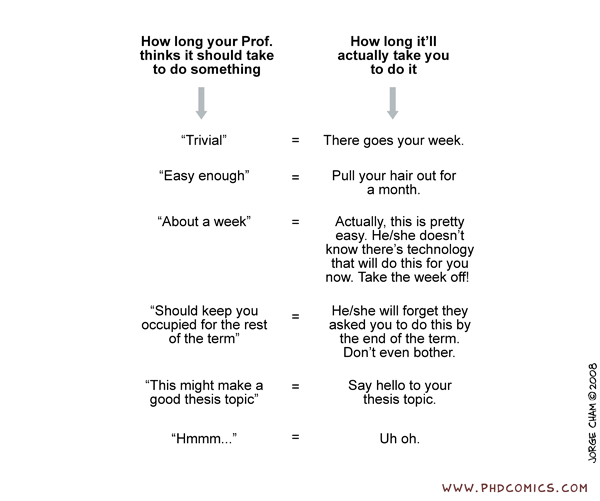
I'll give the final word to Jorge Chan of PhD Comics:
http://cs.jhu.edu/~jason/advice/how-to-work-with-a-professor.html
| Jason Eisner - jason@cs.jhu.edu (suggestions welcome) | Last Mod $Date: 2024/12/16 01:12:17 $ |